BCM212 Portfolio: An opinion piece on how students feel about groupwork & how introverts can survive group projects.

The project deadline approaches in only a matter of days, yet none of your group members have spoken up. The stress nudges you to take the initiative and pull the group together. If not you, then who else? It’s only at the last moment that the team finally comes together and finish the task as a group, and cases do exist where that ends up being a fatal mistake.

As an introvert that struggled in socializing with others, group projects were often the bane of my existence.  It is an unavoidable part of the education experience however, and this made me curious about the sentiments of my fellow university undergraduates regarding group projects.

From gathering this firsthand data, I sought to discover what sort of consistent feelings that students face about group projects and if there was a similar problem amongst them. Should that problem be identified through this small research, it can serve as a heads-up for academic institutions or students in mitigating the issue when they face it.

On my conclusion, I will also draw a few suggestions on successful group management based on this research and personal experiences which can help fellow introverts like myself.

Methodology

For my research, I have utilized questionnaires as a means of gathering quantitative data, with optional open-ended questions towards the end to serve as a means of gathering more qualitative data. I have maintained a strict ethical standard in my survey, as I have provided a clear and detailed consent form for participants to accede before partaking in the research. In respect to the consent form, the identities of the participants are kept confidential, and the information provided are to be used for only academic purposes.

The questionnaire consisted of 25 respondents from the BCM212 cohort. Although it is a modest sample size, the diversity in responses have provided the research with interesting data that will be discussed in the following.

Data Analysis

As my research mainly focuses on exploring how students feel about group projects, a selection of the relevant findings will be discussed in this section.

Firstly, I discovered that 64% of 25 respondents leaned towards thinking group projects were fair, and 36% thinking they were unfair (Figure 1). Feelings are an abstract topic in discussion, but the value in this question is to take a brief glance in possible dissatisfaction from the students.
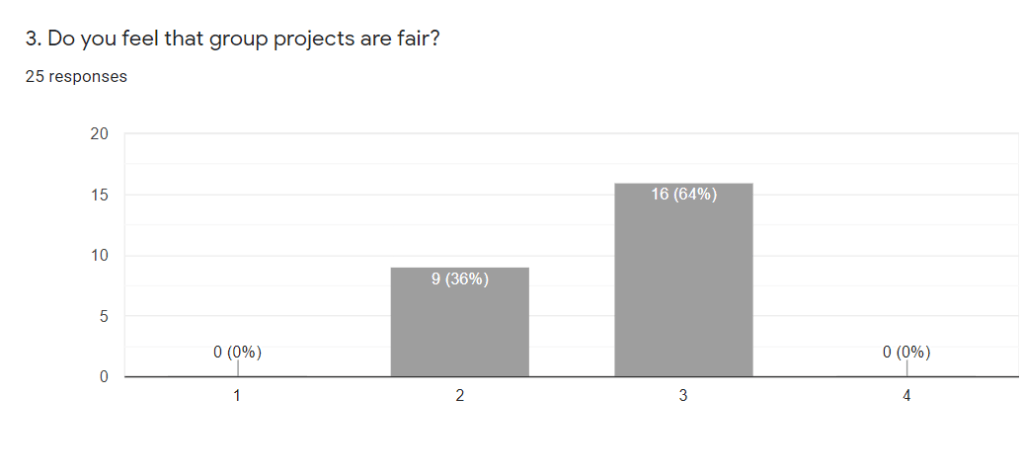
(Figure 1), on a scale of 1 – 4 with 1 being very unfair and 4 being very fair

When asked if group projects made the student feel anxious, 70.8% have answered ‘Sometimes’ while 29.2% have answered ‘Yes’ among 24 respondents (Figure 2). Notably, none of the participants answered ‘No’ to the question which is interesting.
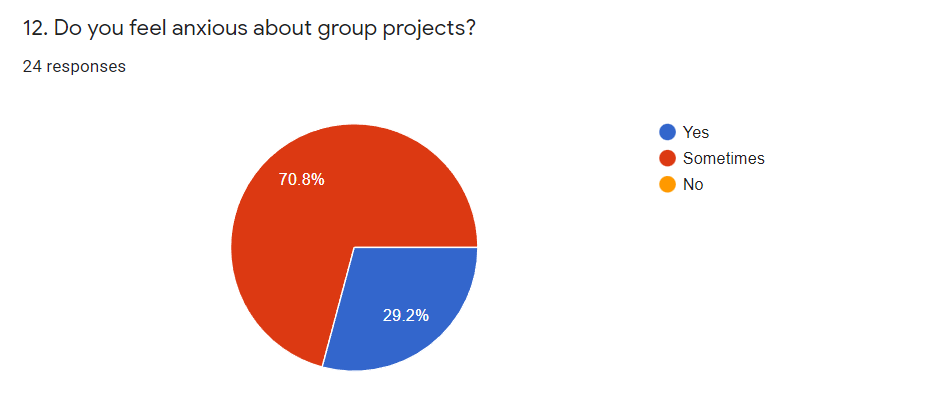
Figure 2

It was also intriguing to find that 60% of the respondents disliked group projects, in contrast to 40% liking group projects. (Figure 3) This question was also directed the participants to open-ended questions respective of their answers.
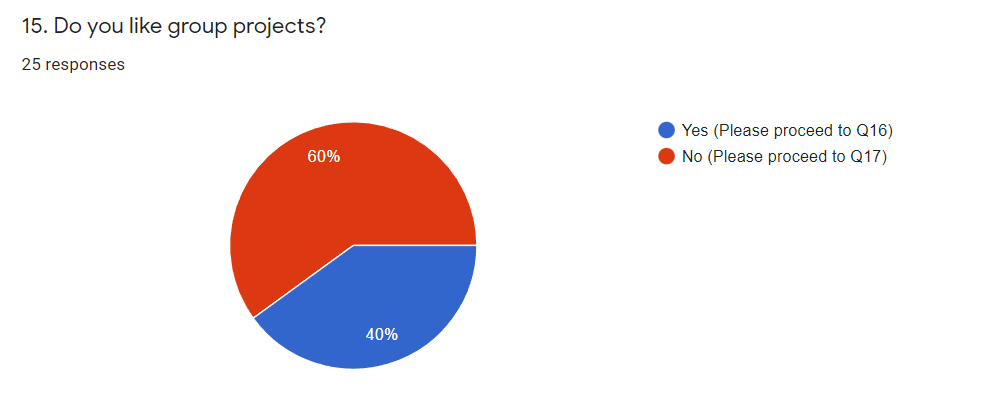
Figure 3

For students that answered that they liked group projects in Figure 4, we can find out that most of the 10 respondents reflect the benefits of group work (Carnegie Mellon University, 2021) and some answers showing cognition of group dynamic awareness (“Why work in Groups?”, 2021)
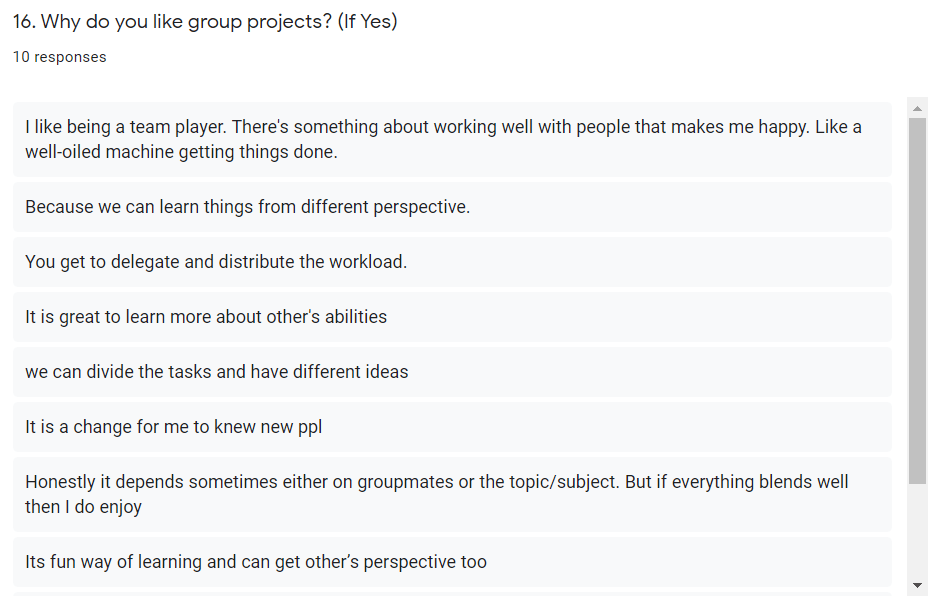
Figure 4

However, there were numerous interesting answers that can be observed from the 14 participants that state why they disliked group projects in Figure 5. The most interesting one is how one mentions that the differing career paths of students cause a misalignment in values that result in a subpar project. The common point in these answers were poor communication skills, especially with dealing with assigned unfamiliar groupmates. (“Resolving group work issues”, 2021)
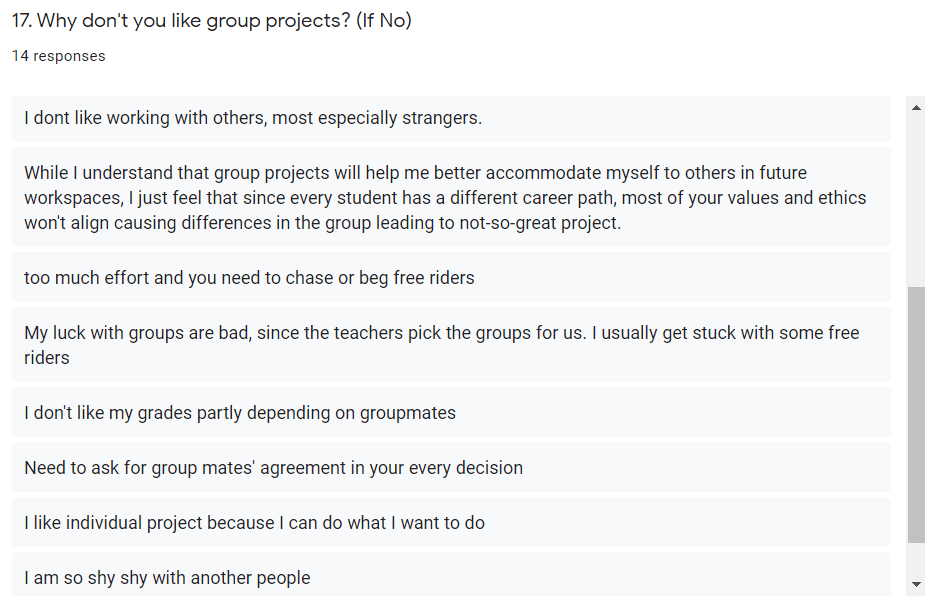
Figure 5

Finally, I have asked two big open-ended questions and received satisfactory and quality input. In Figures 6 and 7, participants were asked about the general challenges and experiences they have in group projects. In figure 6, we can see most of the problem stems from communication or free riders, and some answers share the same sentiment as I do with groups procrastinating until the last moment. Quite a lot of people also mention that they are shy, which makes introversion a likely factor in group work difficulties.
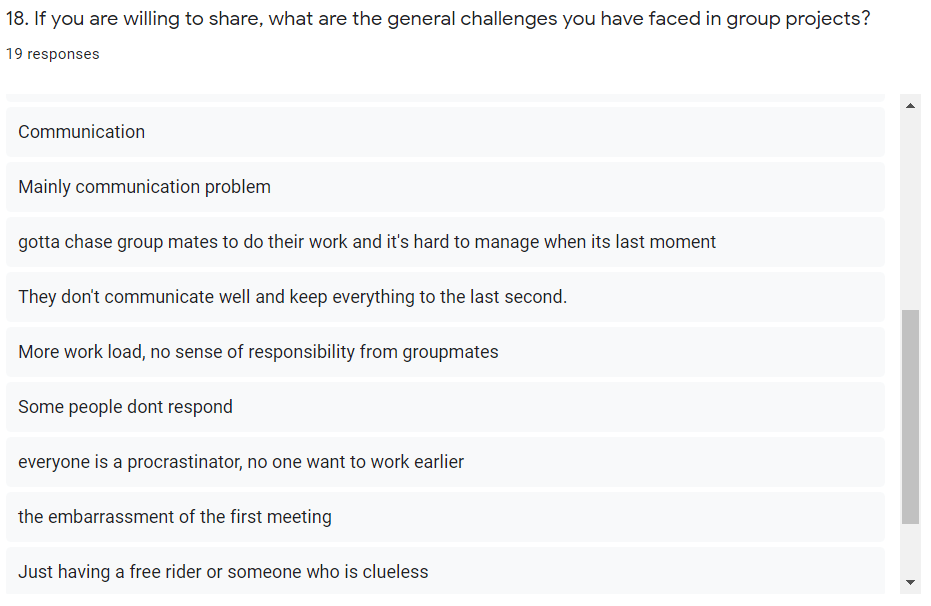
Figure 6

In Figure 7, a respondent talks about a relevant point about group dynamic from their experience as they mention how there are often leaders which act in a tyrannical manner. Some groups may have a member supposing the role of a leader and directing the group to follow only their ideas while not taking the ideas of others into account. I found this a noteworthy perspective, and somewhat relatable as an introvert.
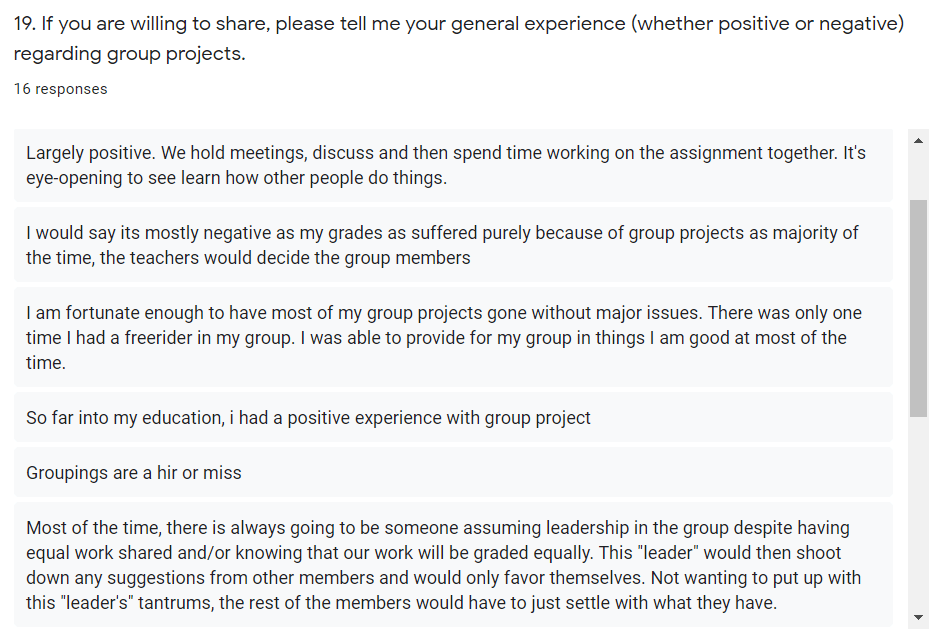
Figure 7

Conclusion

I have learned that other people do share similar experiences with me, especially when looking through some of the answers to my open-ended questions. Many of the reasons also support that the procrastination of group members tend to be a stressing factor that has also happened with other students other than myself, and communication remains as one of the biggest problems that students feel about group projects especially with introverts.

For my suggestions, I would say that it is important to immediately establish a means of online communication with your groups and text assertively. (Madden-Krasnick, 2021) This is something that even introverts can do, and it’s important to pressure your members with reminders before the deadline. It’s also a great way to have your voice heard even if it is difficult in offline discussions.

References

University, C. (2021). What are the benefits of group work? – Eberly Center – Carnegie Mellon University. Cmu.edu. Retrieved 22 November 2021, from https://www.cmu.edu/teaching/designteach/design/instructionalstrategies/groupprojects/benefits.html.

Why work in Groups?. University of Birmingham. (2021). Retrieved 22 November 2021, from https://www.birmingham.ac.uk/schools/metallurgy-materials/about/cases/group-work/why.aspx.

Resolving group work issues. My.uq.edu.au. (2021). Retrieved 22 November 2021, from https://my.uq.edu.au/information-and-services/student-support/study-skills/group-work/resolving-group-work-issues.

Madden-Krasnick, H. (2021). How to survive group projects as an introvert. Retrieved 22 November 2021, from https://students.ubc.ca/ubclife/survive-group-projects-introvert

Digital Artefact – UNLAX

UNLAX Summary

Hong Kong is a very fast-paced and competitive society, and this adds much weight to the value of quality study. For students, there is a lot of stress in keeping up with the demanding education standards and they may not even have access to the right environment for studying especially with the recent pandemic.

UNLAX seeks to fulfill the social utility in dealing with these problems, as the project provides up-to-date information and necessary resources for university students looking for a quality and affordable place for relaxation and study.

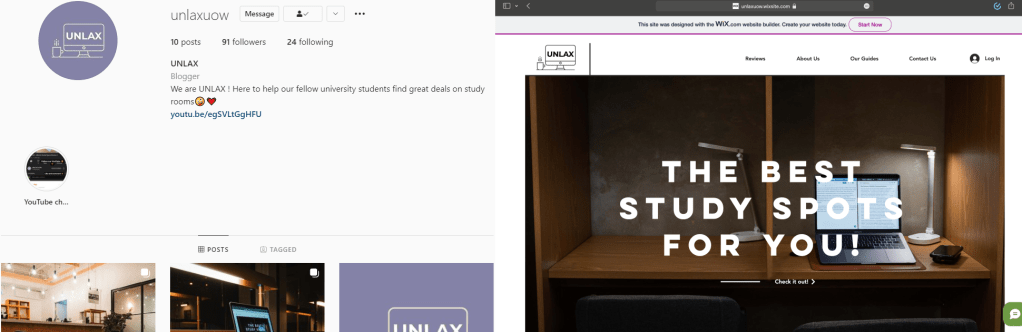
Our Instagram and Blog (left and right respectively)

Our digital artefact features an Instagram page and a blog site, with both of the platforms fulfilling two key elements in the project. Instagram acts as UNLAX’s main means of outreach towards the intended target audience, university students. The platform was also used as a means of conducting user engagement, as well as a effective way for us to advertise in other study-related Instagrams.

Instagram carousels with animated pictures were included as a means of promoting the reviewed study area, and these posts also acted as the gateway to the blog. The blog was meant for providing an in-depth review of the study review, and included promotional videos of its respective study space.


Development Process

In the beginning, we started off as clueless students randomly matched as a group, with none of us having any familiarity with the other.

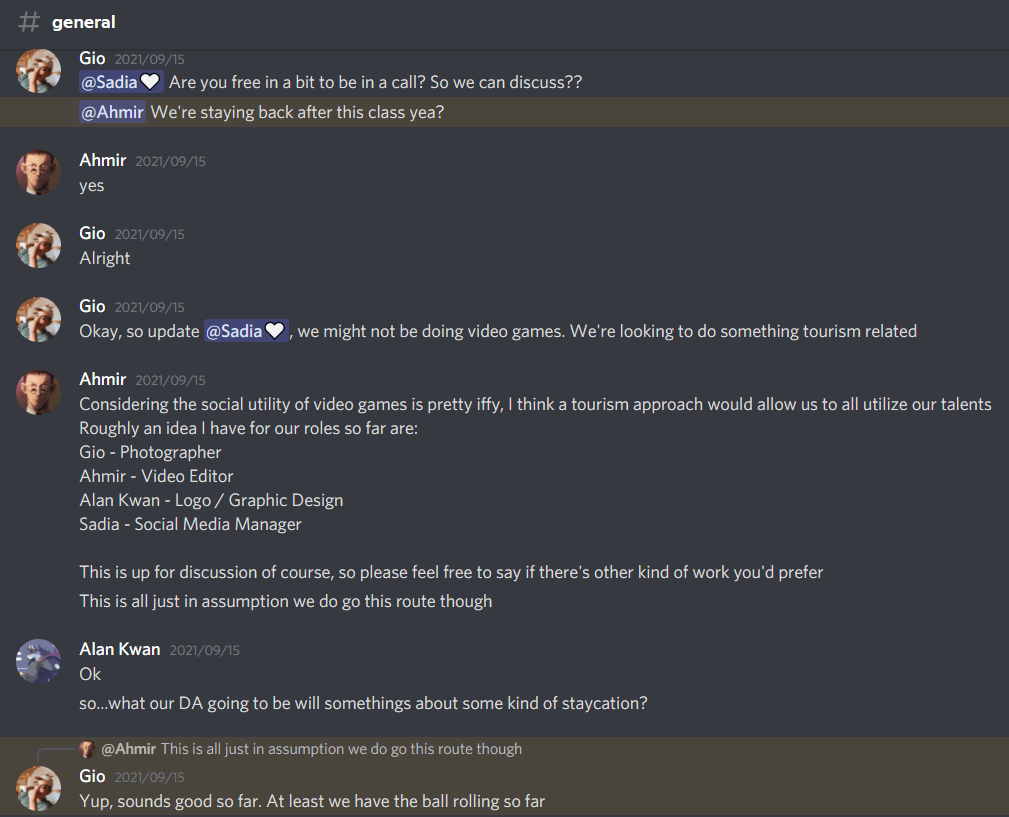
The first thing I did was make a Discord server for the group, which was vital in communicating online as well as sharing various ideas and co-ordination. It was also infrequent that we could manage an offline meetings, thus most of our decisions were made on the messaging app. Each person was promptly delegated into a role based on our skillsets, and my duties became mainly the production side of things as well as communicating with study space companies for their kind permissions.

Our first discussion was also figuring what to do for our digital artefact, and the idea of doing something like ‘game reviews’ became our first lead after discovering a majority of the team composed of avid gamers that shared a common interest. It could be fun, we all thought.

But after a while of consideration, my second thoughts had left me stressed over its lack of virtue as a social utility. It may even end up too time-consuming, and our ideas were lacking any feasible plans to make the project pull through.

The critical decision had to be made as it decided the foundation and course our digital artefact would ultimately be heading with. When I learned of each person’s talents, I figured something that made use of Gio’s photography skills combined with my technical knowledge would have been best.

One of our first Discord discussions, and discussing a major turning point for our digital artefact

In our discussion, we figured out a possible social utility with greater relevance. I felt that our newfound purpose aimed towards helping local students find comfortable study spaces carried more weight, and it could synergize the skillsets of the team in producing such a digital artefact.

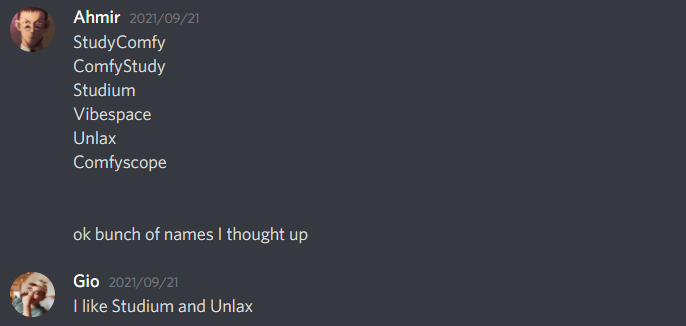
Other names we could’ve possibly been?😏

I then provided a list of names, where the team fancied UNLAX as it was not only the portmanteau of University and Relax. Another fun fact, ‘Unlax’ is a real slang that is actually synonymous with ‘relax’ so it does fit well with our digital artefact’s purpose.

UNLAX had initially planned for using a variety of platforms for the digital artefact, namely Twitter, Instagram, YouTube and Wix for the blog. But maintaining all of these would’ve been extra effort with little potential gain, so we limited our digital artefacts to the blog and Instagram, as the platform has a strong penetration rate with our target audience.

The finalized team organization ended up in respect to the design principles of F.I.S.T, where we eventually managed to maintain a record of weekly updates which in a fast manner. With our focus on locating cost-effective study spaces, the project’s costs were inexpensive. We only required to maintain two social media platforms, namely Instagram and the blog, which adheres to the simple and tiny aspects of the F.I.S.T principles.

With gaining the approval and recognition of the project’s value by our tutor, our project finally began. Though we still got off on a rough start. As the main video editor, I found myself at the brunt of merciless (yet appreciated) criticism on the first review video I made. I was confused and did not have a concrete idea of what to do, resulting in quite a lot of jarring flaws that were kindly pointed out.

This was very much welcomed especially early on, as it teaches the importance of FEFO (Fail Early Fail Often) in iterating to a successful product.

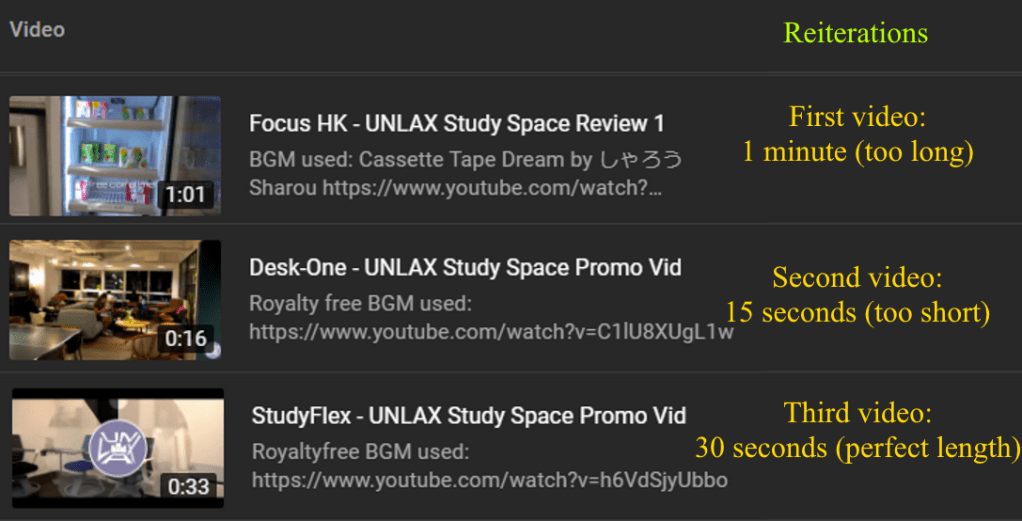
The feedback would have led to several iterations as I kept the advice to heart, eventually perfecting a format where the video was neither too long nor short, and immediately produced the most important tidbits of information for the viewer where the pricing and various key points are introduced in a timely manner within the video.

Just by comparing the first three video reviews, you can see the obvious changes between them. The first one was too long at 1 minute, the second was too short at only 15 seconds, but the third was the ideal duration at the sweet middle point of 30 seconds. Unlike the first iteration, the succeeding videos also kept the UNLAX logo consistently visible throughout the video.

UNLAX reaching 91 followers as of current
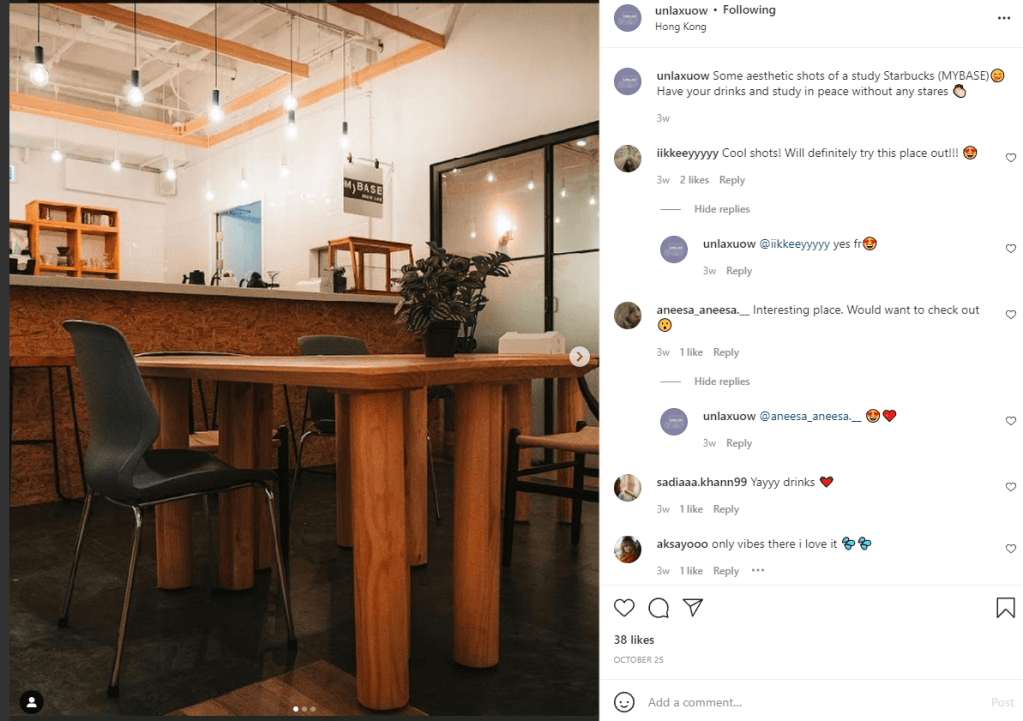
Frequent responses to user comments on Instagram

Our main method of user engagement was through Instagram, with the social department of the team responding regularly to comments. With nearing a hundred followers, it was rather inspiring and encouraged us to continue posting updates weekly.

Overall, I believe the project has turned out quite well and I have learned a lot from this. I have fulfilled my duties as a group member and feel as if I’ve earned experience akin to that of working with a company marketing themselves. Furthermore, seeing the noticeable improvement in my video editing skills in the course of just a few weeks is actually quite inspiring, so I am thankful for the journey so far.

Tracing the rapid emergence of a radical decentralization movement involving decentralized finance

DeFi is on the rise

The easiest place to trace back the emergence of rampant Decentralization among the electronic financial space today would be with Satoshi Nakamoto, the founder of Bitcoin. Back in 2008, he published a paper titled ‘Bitcoin: A peer-to-peer electronic cash system.’ This paper explained what he was trying to accomplish and why.

To summarize, Satoshi explains that he desires for a system that allows for transactions to take place electronically that is completely peer-to-peer, without a third party. He believes that those third parties suffer from the trust based model. Completely irreversible transactions aren’t possible since financial institutions cannot avoid mediating disputes. The costs of mediation increases transaction prices as well, limiting the minimum practical transaction size and cutting off the possibility for small casual transactions.

“With the possibility of reversal, the need for trust spreads. Merchants must be wary of their customers, hassling them for more information than they would otherwise need. A certain percentage of fraud is accepted as unavoidable.”

Satoshi Nakamoto

However, Bitcoin has various systems in place that makes these third parties unnecessary. Decreasing costs, and increasing security and making transactions more public as well. This technology is now known more colloquially as ‘blockchain technology.’, the birth of decentralization in the online financial space.


Blockchains work by having all transactions hashed onto the blockchain. This data cannot be edited without redoing the proof of work, which is the initial step of finalizing a transaction. Proving a transaction, I.E. ‘Proof of work’ requires intense computational power, and can be done by anyone, though only the first one to succeed receives the payment. As a result this process becomes completely decentralized, which will be further explained later on.

As long as no group controls more nodes than the decentralized masses, this system is truly secure. (One would require more than 50% of the world’s processing power on the bitcoin blockchain in order to allow for double spending of coins.)

And with this, the first cryptocurrency, bitcoin was born. A cryptocurrency can be considered an electronic coin that is a chain of digital signatures. Each coin has its transactions added to the blockchain’s database. Without need of mints or other easily broken chains of the financial markets, Cryptocurrency is far more robust against attacks and disruption.

This paper was revolutionary in hindsight, though at the time of its publication it didn’t gather too much success. For many years most of the population considered bitcoin to be a novelty that wouldn’t last. As bitcoin’s popularity rose however, and as the technology became more accepted, Bitcoin’s value skyrocketed. And as a chain reaction, the larger Bitcoin’s value became, the more money one could get out of ‘mining it.’ (Mining is the act of using computational power to provide proof of work services, and complete the equations to have a transaction added to the blockchain.)


As more and more people began to mine, it became more difficult for one entity to try and take control over the blockchain. Decentralization increased. The difficulty of mining increases as hardware advances. The difficulty of Proof-of-Work is determined by a moving average targeting an average number of finished transactions per hour. If too many are generated in that hour, the difficulty increases. This maintains a constant difficulty, which is necessary for security as well.

Bitcoin was the proof of concept, and as it was the pioneer of this technology, it currently has the largest market share in the world of cryptocurrency More than thirteen years later, each bitcoin which was worth significantly less than a dollar upon creation, is now worth over $64,325 as of November 13th, 2021. As one might expect, this immense value attracted investors, inventors, and pioneers of all sorts!

This caused many other cryptocurrencies to spring into action. These cryptocurrencies could range from being entire networks, such as Ethereum, to stores of wealth such as Bitcoin, to being tied to DApps. (Decentralized apps) DApps have other goals in mind. They perform actions, are programs, or are companies and services such as Uniswap. Uniswap allows one to quickly swap their cryptocurrencies for others of equal value, at an extremely fast pace, for a nominal fee. Unlike Cryptocurrency Exchanges which usually require time to pull a coin into your bank account, or to trade with it, Uniswap does it all in moments at the click of a button.

At this point in time there’s even DApps that are being created to allow people to lend crypto and fiat together, or even build homes in Africa using the coins as deeds to rental properties that would be created in their name, using their value. All of these DApps that have been mentioned so far have millions of dollars worth of crypto at their disposals, too.
Suddenly Cryptocurrency was a market, with trillions of dollars invested into it! This created a necessity in the form of cryptocurrency exchanges. There are dozens of them on the internet, hundreds perhaps even. Though a few big ones are the kings so far. Binance, Coinbase, Kucoin, Kraken, these are only a few of the larger exchanges that exist.

A cryptocurrency exchange is a place where you can trade your cryptocurrencies, exchange them for money or other cryptocurrencies, send them to your bank accounts, your wallets or your peers. It acts as a huge middleman that facilitates easy trading and investments into the various cryptos that exist in this world.

Thanks to these exchanges as well as hype from celebrities and extremely rich people (i.e. Elon Musk) there has never been more interest and money in the crypto market. Although many people only consider it an investment opportunity, more and more people believe in the idea of decentralized finance. In many countries those in power leverage their money to keep the poor in poverty, or simply churn out so much money that massive inflation keeps everyone getting steadily poorer anyway.


Because Cryptocurrency is growing, expanding, and researching new technology at such an alarming rate, banks and other financial forces have begun to try and crack down on Cryptocurrencies in general, the exchanges, and other such things. Most notably the FATF (Financial action task force) has begun to roll out its cryptocurrency mandates, and has levied fines against some, such as USDT.

We are currently in the midst of a battle. And a possible shift in electronic payments in the future. Cryptocurrency is growing, and their ideals of decentralized finance seem more and more possible as billions of dollars leaves bank accounts to be put into cryptocurrencies. At the same time, many laws will be passed that could limit their use across the world.

Many people believe in decentralized finance, or simply don’t trust banks. Many other people feel the opposite. Time will tell what the future holds for these industries.

References:
https://bitcoin.org/bitcoin.pdf
https://medium.com/@VitalikButerin/the-meaning-of-decentralization-a0c92b76a274
https://vitalik.ca/general/2021/03/23/legitimacy.html
https://www.fatf-gafi.org/publications/fatfrecommendations/documents/guidance-rba-virtual-assets-2021.html
https://www.forbes.com/sites/theapothecary/2021/10/07/in-el-salvador-more-people-have-bitcoin-wallets-than-traditional-bank-accounts/?sh=4b1e078320b5

BCM222-Visual Essay Pitch on Techno-Orientalism

References

ROH, D. S., HUANG, B., & NIU, G. A. (Eds.). (2015). Techno-Orientalism: Imagining Asia in Speculative Fiction, History, and Media. Rutgers University Press. http://www.jstor.org/stable/j.ctt1647cqh

https://www.tandfonline.com/doi/abs/10.1080/09528829908576801?journalCode=ctte20

https://vulcanpost.com/621687/what-to-expect-hatsune-miku-expo-concert-kl/

https://www.vogue.com/article/hatsune-miku-dance-moves-gifs?mbid=social_onsite_pinterest

https://en.wikipedia.org/wiki/Blade_Runner

https://en.wikipedia.org/wiki/Ghost_in_the_Shell_(2017_film)

BCM206 Beta – UNLAX

UNLAX Beta Video

In this blog post, I will discuss about how our project idea has evolved into where it is today and share with you my perspective as one of UNLAX’s members.

The development of UNLAX has been a memorable journey thus far, especially when looking back at the numerous iterations it took for our team to pull through. In hopes of fulfilling some social utility that would benefit us and prove as a relevant digital artefact, we figured out that our calling was to identify ways to help fellow students like ourselves have a smoother and relaxing studying experience despite the fast-paced and competitive society in Hong Kong.

The UNLAX team has designed the digital artefact with the concept of F.I.S.T in mind. We have proven that we were able to provide weekly updates with procedures that can be done fast. Our budget has also been kept inexpensive, as our aim was to locate cost-effective study spaces. To keep the digital artefact simple and tiny, our initial plans for having multiple social platform coverage has been reduced to only the Instagram and our blog which we can manage without requiring too much time or resources. We have also effectively distributed our members into suitable roles with the division of labor in order to accomplish an effective teamwork in carrying out the UNLAX project.

Though our ideas had many reiterations thus far, we kept a few fundamental ideas consistent to the end. Firstly, it is the blog. It is certainly debatable whether it is necessary, but we needed a platform that can archive and store in-depth reviews for our interested followers that are looking for a study space to stay. Instagram comes into play here, as our main means of promotion. Instagram has the biggest outreach to our target audience as a major social platform, so we have uploaded eye-catching pictures and even included animated maps to the study spaces as a quick guide for our followers to refer to.

At the time of writing this, UNLAX has reached 91 followers.
One of our most noticeable iterations, the change in our logo to adopt a more minimalistic and professional feel.

On the production side of the team, my role is to provide promotional videos which also contain quick informative bits about the location while also showing the beauty of the interiors. These videos can mostly be seen on the review blog website. I believe showing these series of works I’ve made proves reminiscent of the FEFO concept, where one should fail early and often in order to achieve success in the long run.

At first, I must admit that I did not have a clear idea of what to do but I had to produce a promotional video nonetheless in my personal vision. But every beginning has its flaws, and as FEFO (Fail Early, Fail Often) had taught, I was able to learn more ways in improving my promotional videos for the team. The problems that my first video initially had was that it was too long (being a minute long) and it did not have the UNLAX logo stick throughout the video. The prices were also not really shown until a long period of time later.

Taking the criticisms to heart, I made a much shorter variant this time with the logo consistently visible on the bottom right corner of the screen. The prices were shown much faster as a result, and I thought the message was quick and direct. Unfortunately, this iteration may have been too short as criticized and there was not much time to introduce the different facilities within.

This video set the standard for UNLAX’s future promotional videos, because it is the reiteration that fixes the problems of my previous promotional videos. Around 30 seconds was the perfect length as the middle ground between my first and second video which were too long and too short respectively. This iteration introduces each room while also providing sufficient information in an aesthetically pleasing way.

Thank you for reading my blog post, and please continue to look forward to UNLAX’s service!

BCM241 Digital Artifact Pitch

To clarify on a few more things in the above video, what I mean by spreading awareness is to expose the niche to the non-gamer audience because I believe that pixel art has more potential than just being part of the game industry.

I plan to include other news related topics on pixel art, especially in ways that it gains notice even without the concept of gaming applied to it. The rise of NFTs is a very good example of pixel art that has gained an online media prevalence without it being associated with gaming. By different styles of pixel art, I also wish to include the mix of landscape art, looping animations, fan art, and etc. to show various means of how pixel art can be applied.

Having discussed the ethical concerns of producing fan art in the previous blog, I will adhere to the associated franchise’ regulations on the pixel art when I post them on my Instagram account.

References:

Tad on Music (2021). Retrieved 26 October 2021, from https://www.youtube.com/watch?v=4bh0e2iROgk.

gameranx (2021). Retrieved 26 October 2021, from https://www.youtube.com/watch?v=VXj5-GJSna4.

kaynimatic (2021). Retrieved 26 October 2021, from https://twitter.com/kaynimatic/status/1294982862710611968.

Japan pixel art gifs. Imgur. (2021). Retrieved 26 October 2021, from https://imgur.com/gallery/21Fpbug.

BCM241 Blog 4: Academic research & Ethical Issues

Academic Research

In the previous blog post, I identified a few problems that are possible with my media niche. Therefore, this section will explore relevant background research in discovering possible solutions and interesting data on the current state of my pixel art niche.

Looking at the general overview of pixel art as a whole, one can think of it as a rising trend nowadays. Because there are more indie game developers entering the game industry, many are adopting the retro style due to its quirky and distinguishable nature.

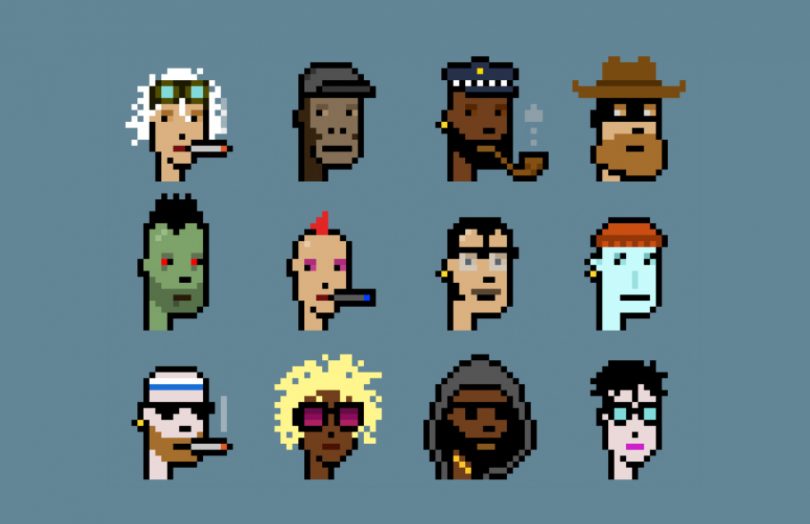
Furthermore, there are recent technological advancements that present the retro art style and broadcasts the niche to wider audiences. An example is the rise of Non-Fungible Tokens (NFTs) where the pixel art style is now experiencing a surge in its notability. A major influence to this sudden rise is CryptoPunks, an NFT project that generated thousands of NFT avatars in pixel art form.

CryptoPunks signs agency deal with UTA to license NFTs to mainstream media  - Ledger Insights - enterprise blockchain
Pixel Art being used for NFT by CryptoPunks | Image by Christie’s / Larva Labs

In recent years, they have become extremely valuable collectables that can potentially sell for millions of USD. Since NFT’s explosion in popularity in February, CryptoPunks has become a highly sought-after NFT collection. For instance, Two alien punks avatar sold in March for more than $7.5 million each. In just a few months since then, seven more avatars have sold for more than $1 million. (Kastrenakes, 2021)

It is crazy to imagine how these little avatars could fetch such high prices, and it’s encouraged many people nowadays to delve into pixel art. Myself included. We can see the demand for pixel art exists because there are people willing to spend millions on NFTs in their style. The rise of NFTs has proven and justified pixel art as a style that is highly valued, which challenges my previous thought in Blog 3 where I believed pixel art was considered a ‘low art’.

Ethical Issues

When considering any possible ethical issues that may arise from pixel art, it is a simply a style of art, so it is a bit too broad to define any. Therefore, we will shift our perspective to how a pixel artist handles intellectual property. These ethical issues apply for most forms of art, but it is worth a discussion.

In my Blog Post 3, I’ve presented a few pixel art that are actually ‘fan art’ of existing franchises. In my own experience as a pixel artist, there are also times where I make pixel art for characters that I like.

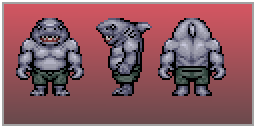
This is an example of my pixel ‘fan art’ of King Shark from The Suicide Squad by DC Universe.

Fan art of ‘King Shark’ belonging to Warner Bros. Entertainment Inc. All Rights Reserved.

It is originally produced as a personal practice of sketching my favorite character from the show in different angles.

In order to comply with their terms and condition for the creation of this piece, I followed the guidelines set by the company that owns the rights here: https://support.dcuniverse.com/hc/en-us/articles/360035343533-FanArt-Submission-Guidelines

Essentially, it is a non-profit piece of fan art that does not contain any political / religious messages and the design remains faithful to the original. It does not contain any defamatory or damaging elements in the design that may harm the character’s image. If the original owner of the art were to request removal, I would immediately take down the image.

There are legal consequences to not abiding to the guidelines, and if I intended to profit from fan art then I realize I must first consult the copyright owner with a formal letter and their permission for the greenlight. Interestingly, in recent news, DC has even banned artists from selling their work as NFTs.(King, 2021)

Fan art is a strange case in legality, as most presented online are actually infringements without exception. Most people do not contact the copyright owners especially when they are famous characters, however many companies tolerate the creation of fan derivative works and some even encourage it as a form of promotion.(Bailey, 2021)

The safest way to proceed as a pixel artist is to simply make my own characters for my own work, so there is no need to deal with the complicated legal world. Otherwise, I will need to look for the original IP owners especially if I wanted to use their copyrighted characters for commercial purposes.

References

Larvalabs.com. 2021. CryptoPunks. [online] Available at: <https://www.larvalabs.com/cryptopunks&gt; [Accessed 16 October 2021].

Kastrenakes, J., 2021. CryptoPunks NFTs sell at Christie’s for $16.9 million. [online] The Verge. Available at: <https://www.theverge.com/2021/5/11/22430254/cryptopunks-christies-sale-larva-labs&gt; [Accessed 16 October 2021].

DC Extended Universe Wiki. 2021. King Shark. [online] Available at: <https://dcextendeduniverse.fandom.com/wiki/King_Shark&gt; [Accessed 16 October 2021].

King, S., 2021. DC Just Banned Its Artists From Selling Certain Art. [online] ScreenRant. Available at: <https://screenrant.com/dc-comics-banned-artist-nft-sales-art/&gt; [Accessed 16 October 2021].

Bailey, J., 2021. The Messy World of Fan Art and Copyright – Plagiarism Today. [online] Plagiarism Today. Available at: <https://www.plagiarismtoday.com/2010/05/13/the-messy-world-of-fan-art-and-copyright/&gt; [Accessed 16 October 2021].

BCM206: The Network Society Paradigm

Source: https://blogs.icrc.org/law-and-policy/wp-content/uploads/sites/102/2020/06/Hacking-4-image-2.jpg

Humanity had never lived like the now, when you take a look at historical records of centuries ago. It goes to show the great changes brought about by this new era, ever since the advent of communication technology that had proven mankind’s victory over time and space constraints, the radio telegraph.

Information and matter was now decoupled, and this paradigm shift eventually brought rise to a network society where space and time were homogenized, a world wide web that is constructed with code and thought as its building blocks. As written by Marshall McLuhan in his book, ‘The Gutenberg Galaxy’, “The new electronic interdependence recreates the world in the image of a global village.”

There is no society more vast, expansive and as globally connected as the Internet nowadays. The Internet bypasses the physical borders of reality, and allows everyone online to connect with one another in the form of mind. The term ‘Cyberspace’ was coined by William Gibson in his book “Neuromancer”, referring to this digital environment made possible by the interconnected computer technology. In William Gibson’s definition of the word, “A consensual hallucination experienced daily by billions of legitimate operators. A graphic representation of data abstracted from the banks of every computer in the human system.  Lines of light ranged in the nonspace of the mind, clusters and constellations of data.”

Global networks and military use

The first widespread use of these technological advancements like satellites, the radio and global networks were initially used for warfare. These revolutionary technology would greatly favor nations in war. With swift implementation of radio technology, it allowed a network to be established for soldiers in battle. Through this network, commands could be issued and information could be constantly transmitted depending on the tide of the battle. Global networks had powerful strategic value, and wars could be won with real-time co-ordination.

There were various types of network topologies, and I will discuss two of them and their differences in this blog. 

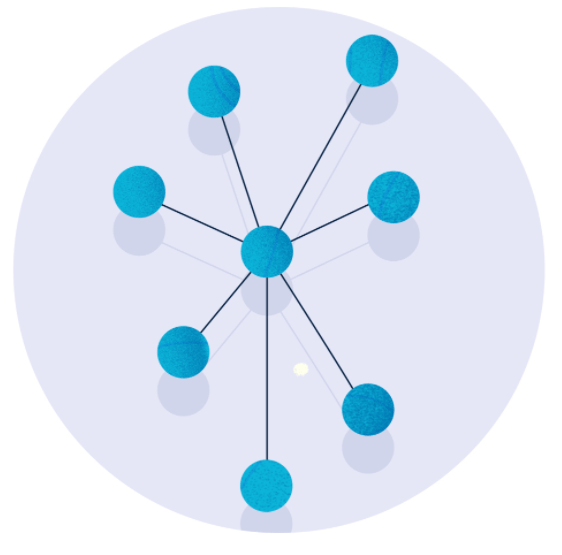
Source: https://cryptopostgazette.com/wp-content/uploads/2020/01/20181220-Blockport-illustration-2-2.1.jpg

Star Network Topology. Consider the middle of the above diagram as the central node, and the surrounding nodes relying on it as they are all connected. Because of the centralization, data synchronization is more efficient and data storage within the central node is possible. Data processing may also be distributed evenly across all nodes. However, should the central node fail, the star-shaped topology network would shut down.

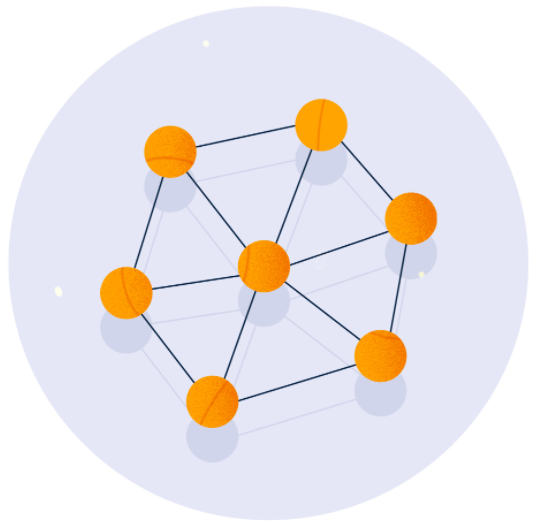
Source: https://cryptopostgazette.com/wp-content/uploads/2020/01/20181220-Blockport-illustration-2-2.1.jpg

Distributed Network Topology. Unlike the star network topology, it does not rely on a central node for data transmission and communication. Therefore, it cannot shut down due to any node experiencing failures and the network can still continue to function. Each node have equal access to the network, however data storage may be lost if a node ceases to function.

With the concept of nodes being explored, let us discuss how they acted in shaping the network society of the future.

How the Network was Shaped by Network Openness

When the Network Society was built by the connection of millions across the globe acting as nodes, people brought and introduced culture from all across the globe in the form of communication. This was an entirely decentralized, distributed network. Innovation, dreams and all sorts of different projects would be start up and further expand the network with content. There was a sense of liberty in all of this, made possible by the endless amount of content being uploaded online.

The global network processes all the different data brought across the world, establishing a social structure that cannot be governed entirely as a whole by authorities. The Internet does not have a central node, and has billions of nodes scattered across the world which makes it a distributed network topology. Each person on the Internet is capable of uploading and transmitting information online, giving form to the Internet that we now know today.

Cyber-Utopianism

The cyber-utopianism is a belief where civilization is built by the minds of humanity. A world where anyone can choose to hide behind anonymity, and would be able to share and communicate their thoughts and beliefs without needing care of their identity, social status, gender nor race.

It is a world where you can even adopt an entirely new persona, one shaped by mind. It is a cyberspace ruled by no government, and built upon by the collective actions of the many minds that contribute to the global network society with a free flow of information. It is a digital utopia constructed by decentralization, and both libertarian and democratic as it is a world shaped by the mind of people, not by an authoritative figure.

References:

Gugliotta, G., 2021. How Radio Changed Everything. [online] Discover Magazine. Available at: <https://www.discovermagazine.com/technology/how-radio-changed-everything&gt; .

Perry Barlow, J., 2021. A Declaration of the Independence of Cyberspace. [online] Electronic Frontier Foundation. Available at: <https://www.eff.org/cyberspace-independence&gt;.

MCLUHAN, M. (1962). The Gutenberg galaxy: the making of typographic man.

BCM241 Blog 3: Planning My Approach

It’s always a wise idea to consider the difficulties and setbacks when planning to delve into a niche, because trying to find success in a unique market than the mainstream will often require an investment of more time and effort. Thus, I shall problematize my niche based on my personal experiences thus far.

Problematising

When working in the art industry, a general fear that many artists have is the risk of creative burnout. These burnouts are especially deadly when an artist relies on their work as a job, especially because they can last for days or months and lead to a lower quality. From my view, I’ve experienced also having to struggle with perfectionism and a fear of failure. Being too conscious about your art can lead to a constant dissatisfaction, which runs the risk of having a burnout. These burnout symptoms can last from days, months, or even years.(Abigail, 2021)

Another problem is the value of pixel art and its demand. Though there exists games which adopt the pixel art styles, it is still niche as not many modern games adopt the style. It is also fairly limited in value in comparison to learning vector art, UI design, 3D modelling, rigging and etc. which are all skills that are in demand also outside of the game industry, which means more job opportunities that appeal to a wider range of audience.(Is pixel art in demand?, 2021) The general conception of pixel art is that it is often only seen in video games, and rarely seen outside of the game industry. We can then consider the concept between high and low art, which discusses if some forms of art are “higher” than others. (Plescher, 2021).

Using the high and low art concept, we can find that pixel art which possesses notable uniqueness is susceptible to appealing to a narrower range of audiences. In this case, as it is often present in video games, it can be classified as a ‘low’ art and can mostly only appeal to the younger demography (as more youngsters play video games). ‘High art’ are often fine art paintings which carry a contemplative message or deep meaning, and these traditional styled paintings still fetch a high market value in the modern art world. Despite the distinctly noticeable nature of pixel art, the problem is that it could be considered low value art.

Planning

In consideration of all these problems, in-depth research proves necessary in discovering solutions to these problems. As the aforementioned main concerns involves the possibility of burnout and the demand of the niche, I believe the best way to find success in this field is to follow the most famous pixel artists through observation and analyze their strategies and my own with autoethnography. What makes them successful and constantly being able to produce top quality work?

So my decision is to follow a few blogs from famous pixel artists, such as CJ (@cjs_art) and Aduare (@Aduare_rp) who are my inspirations. Here are examples of their works:

CJ’s pixel art of the character “Ichimatsu” from the Osomatsu-kun series
Aduare’s pixel art of “Ayaka” from the popular mobile game, Genshin Impact

They have an aesthetic that is closest to my interest, and still have a variance in style. I’ve also chosen to follow artists specifically if they have a Twitter, so I can have an idea of their daily schedule and how they think when they produce such works. And since anime styled characters are popular with the nowadays generation, I feel like the combination of pixel art and anime style can help in maintaining relevance with the nowadays trend, even if pixel art is considered old-school. In fact, the combination of the two styles may even make the style more niche.

Scheduling

DateTo-doTime investment
Week 5Research on market demand, follow talented artists for inspiration.10 min-1hr
Week 6Making the pitch video, note down what needs improvement for future task.3-6+ hrs
Week 7Referring to pitch video results, focus on improvement and in-depth research.1-2 hrs
Week 8Consider drafts for Digital Artefact and ideas of what to include.1-2 hrs
Week 9Application of ideas for Digital Artefact, and structuring research report. 1-3 hrs
Week 10Creation of Digital Artefact prototype, list important findings for research2-4 hrs
Week 11Finishing touches for Digital Artefact and submission, complete reportAs much as possible

References

Abigail, T., 2021. Why Burnout Is Dangerous And How You Can Recover From It – Toggl Blog. [online] Toggl Blog. Available at: <https://toggl.com/blog/recover-from-burnout&gt;

Boardgamestips.com. 2021. Is pixel art in demand?. [online] Available at: <https://boardgamestips.com/monopoly/is-pixel-art-in-demand/#Is_pixel_art_in_demand&gt;

Plescher, M., 2021. High and low art | The Rapidian. [online] The Rapidian | therapidian.org. Available at: <https://www.therapidian.org/high-and-low-art&gt;

BCM206 Project Pitch

Five tips for studying with friends | ITC Blog

It’s very important to study as a university student. But it’s not necessarily a process that should always be done alone, as there are plenty of people who would rather study and hang out together with their friends in the process! In fact, it might even just be the best way for certain types of people to learn!

However, it might be tough finding places for groups of friends to hang out. There is always the COVID pandemic to worry about as well, with forming groups even possibly being limited with under the event of an outbreak.

This is why me and my group’s Digital Artefact “Unlax” focuses on tackling these issues, providing up-to-date information and resources for university students looking for a comfy, affordable place with their friends to hang out, relax and study.

Our digital artefact’s name “Unlax” is a portmanteau created by the two keywords “University” and “Relax“. In the spirit of our project’s name, we seek to provide an insight on Hong Kong’s many havens where relaxation is the priority as well. We hope to promote group studying as well, because not only is it a fun time, it can be a relaxing way to cope with the hardships of studying rather than doing it alone!

Our logo, courtesy of our group member Alan Kwan.

The idea is comparing different staycations/study areas prices in Hong Kong and their features with our model of an ideal study spot, namely:

  1. Cost-effective (Below $200)
  2. Comfortable, air-conditioned, and clean.
  3. Strong and stable Wi-Fi
  4. Provision of free catering
  5. Quiet environment
  6. Printers and possibly computers.

We intend to individually check out each study area through actually visiting these areas ourselves, and then post our reviews through our blog, Instagram and Twitter. The videos would be showcased on our YouTube channel too!

Our target audience are university students, and most university students already have the aforementioned social media. We hope that our project would be able to reach them aswell!