BCM212 Research Proposal: Group projects in the perspective of university students.

Tips to Work Effectively in Group Projects | Fastweb

 Two people are better off than one, for they can help each other succeed., (Ecclesiastes 4:9, The Bible)

Group projects have always been conducted in educational systems, and its benefits have thoroughly been researched to truly incentivize student’s learning.[1] It cannot be denied that a collaborative effort between individuals will often result in a noticably impressive work, especially when each person plays their part.
This shows how vital this concept is, but even so, why does there exist a notorious discontent amongst students regarding group projects? How do some groups manage a successful project but others can result in the opposite? Are there methods to balance these two contrasts better?

“At their worst, team projects force high-achieving students to compensate for those less willing to put in effort. At their best, they foster productive collaboration and idea sharing among future professionals.”[2]

[How do university students feel about group work?]
I put forward this research proposal in hopes of exploring how university students feel towards group projects, and suggest applicable strategies which can help promote efffective group systems within the college. Through studying the satisfaction of students in regards to group projects, there may be an overlooked approach which can improve the group project system.

To achieve this, I will explore both the positive and the negative arguments for academic group projects, the differences in the methodology of grouping, while also discerning the existing factors that influence the outcome of a group project for university students.
It is my hope that this research may be able to provide an interesting insight to the college from the perspective of the students.

Research Methodology

In the time of writing my proposal, my present primary research methodology can only explore the answers of this year’s cohorts of 33 students, yielding about 13-14 responses for my Twitter poll. This makes up for roughly a response rate of about 39-40% from my coursemates. However, they still provide interesting results which validates the research topic.
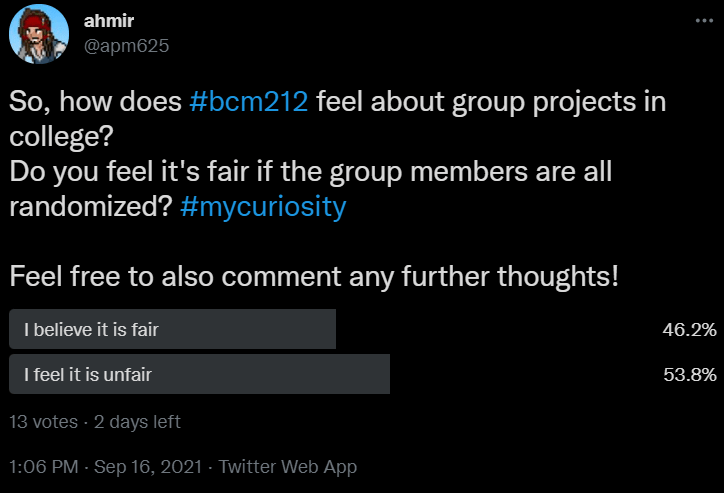
In the first poll, I asked if students thought it was fair if they were placed in group projects with random people. Using the word ‘fair’ was intentional, as it is a subjective word that fits my inquiry about the respondent’s emotions. We can notice that this question has elicited a mixed reception within these 13 students, with 46.2% believing it is fair, versus 53.8% believing it is an unfair method. However,it is also worth noting that a student had commented on this poll, stating that it is understandable in preparing students for the unpredictable workforce.
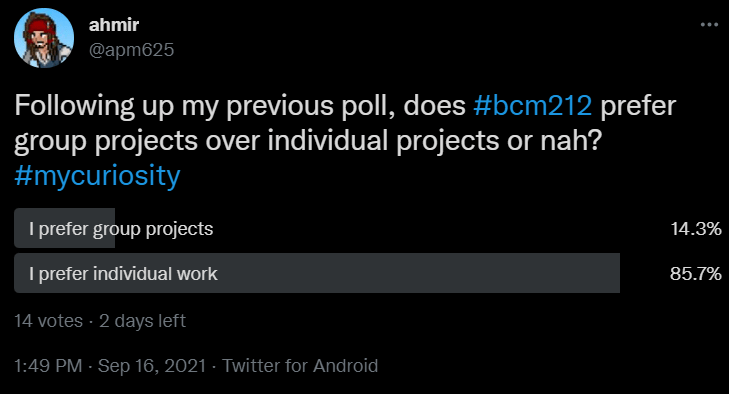
In my second poll, there is a very noticeable inclination towards students preferring individual work over group work. These findings hint at an underlying problem from the student’s perception of group work, and that my research should focus on identifying these causes.

In the next phase of my research, I intend to explore various methods of how students could be grouped, what can the students and teachers do in promoting quality group experiences, and if the faculty should consider marking students as a whole by group, or as individuals based on contribution.

Brief Scope Into Research

A brief scope into my research includes this NCBI research paper titled ‘Group Work‘, published 2018.
The paper mentions recommendations on how instructors and students can promote quality group experiences, with the following methods borrowed from this study:

  1. Students should be assigned specific roles based by talent and background. By establishing proper roles for students, it provides them with a purpose they can immediately pursue. (p. 17)
  2. The paper also mentions an interesting idea where groupmates would evaluate eachother when conducting long group projects. It immediately identifies individual contributions and can bring immediate attention on changing the group dynamics. (p. 12)

In this article by Inside Higher ED published in 2018, there is a brief section discussing different methods of grading group projects should they be graded individually or as a whole. The main issue with grading groups as a whole is that, assigning a single grade to a group of students can mean rewarding underperforming students for letting their peers complete most of the work, or marking down students who tried their best for a project that didn’t come together.(Mark L, 2018, .p 27.)

TeachHUB’s article on ‘Ways to Arrange Students For Group Work‘ explores the difference between teacher-assigned groups and student-chosen groups.

  1. Allowing students the autonomy of choice in the classroom in picking their groupmates can allow them to easily establish communication and involvement in the process. It’s the most effective in group harmony, as everyone knows their strengths and limits.
  2. Teacher-assigned groups introduce a lot of challenge, and as this is the most common mode of arranging groups, it is the riskiest as the student may not be able to coordinate with others as well as in a group where they can be with familiar people.

Finally, this research paper from Cogent Education titled ‘I hate/don’t hate/still hate group projects! A
tripartite ethical framework for enhancing student collaboration
‘ by Jeffrey W. Murray gives a good view on the perception of students regarding group work. From the abstract, we see that students dislike group projects due to their grades potentially being jeopardized when it comes to being grouped with others that do not contribute. (p.1) Ending up in dysfunctional groups seem to be one of the biggest fears for students in group projects.

References:

Hammar Chiriac, E., (2021). Group work as an incentive for learning students experiences of group work.(
https://www.ncbi.nlm.nih.gov/pmc/articles/PMC4046684/) [1]


Lieberman, M. (2021). Group projects in online classes create connections and challenge instructors | Inside Higher Ed. Insidehighered.com. Retrieved from https://www.insidehighered.com/digital-learning/article/2018/04/25/group-projects-online-classes-create-connections-and-challenge.[2]


Chang, Y., Brickman, P., & Tanner, K. (2021). When Group Work Doesn’t Work: Insights from Students | CBE—Life Sciences Education. CBE—Life Sciences Education. Retrieved from https://www.lifescied.org/doi/10.1187/cbe.17-09-0199. [2]

Livingstone, David & Lynch, Kenneth. (2000). Group Project Work and Student-centred Active Learning: Two different experiences. Studies in Higher Education. 25. 325-345. 10.1080/713696161.[3]


Wilson, K. J., Brickman, P., Brame, C. J. (2018). Group work. CBE—Life Sciences Education, 17(1), fe1. 10.1187/cbe.17-12-0258 (https://www.ncbi.nlm.nih.gov/pmc/articles/PMC6007768/)

Kiser, S., 2021. Ways to Arrange Students for Group Work – TeachHUB. [online] TeachHUB. Available at: <https://www.teachhub.com/classroom-management/2019/09/30-ways-to-arrange-students-for-group-work/&gt;

BCM212- Research Pitch

[How do university students feel about group projects?]

Why I want to explore this research topic

“Group projects can help students develop a host of skills that are increasingly important in the professional world” (Caruso & Woolley, 2008; Mannix & Neale, 2005). “Positive group experiences, moreover, have been shown to contribute to student learning, retention and overall college success” (Astin, 1997; Tinto, 1998; National Survey of Student Engagement, 2006).

Group projects allow the collaborative efforts of students with varying talents to tackle a goal together, and there are plenty of projects that have ended up looking professional as a result. Teamwork makes the dream work, afterall.

However, not every group can fulfill this ideal.

“Students often have to deal with difficult issues such as getting credit without doing equal work, poor communication, culturally different approaches to work, lack of (formal) leadership, varying work ethics, and different grade expectations.”(McGraw and Tidwell (2001)

There may be an unsatisfactory experiences within group projects, perhaps due to the struggles in the division of labor or the lack of initiative. There are also the case of freeloaders, and the burden being placed on one or few individuals that struggle to compete with the fellow rivaling groups. 

To prevent further such cases from happening again, I also would like to look into how to coordinate such a group despite the odds and bolster teamwork together – or how universities can improve the group project experience as a whole.

The purpose of this research topic

I want my research to explore these inner sentiments of college students, and take an in depth analysis if there are ways for the education system to resolve these problems.

From identifying different approaches in how courses may assign groupmates, I would be able to list the pros and cons of each method, such as:

  • What if groups were assigned by random?
  • What if groups were made by the students themselves?
  • What if groups were assigned by each member’s talents after identifying them?

I may even discover more methods through the opinions of others after collecting more data.

In conclusion

I believe that a thorough look into this topic can result in a more happier, and fairer university experience for everyone. This topic may also serve as an interesting point of reference for colleges or other related researches.

Thank you for reading.

References

Caruso, H.M., & Wooley, A.W. (2008). Harnessing the power of emergent interdependence to promote diverse team collaboration. Diversity and Groups. 11, 245-266.

Astin, A. (1993). What matters in college? Four critical years revisited. San Francisco: Jossey-Bass.

McGraw, P., & Tidwell A. (2001). Teaching group process skills to MBA students: A
short workshop. Education & Training, 43(2/3), 162-170.

Identifying the Field Site

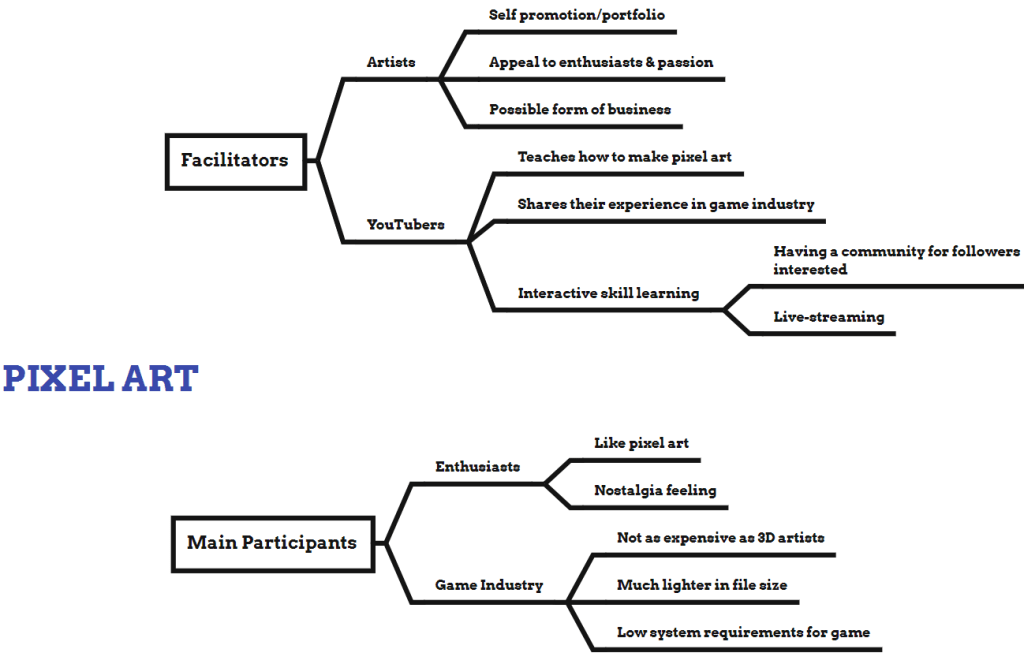
As shown in my previous blog post, my niche is pixel art, which is a style of art. It’s distinguishable, and not something seen very common which holds true to the characteristics that I would consider ‘niche’. That is why it is especially important to fully delve into this topic and investigate if it is fitting to be a valid digital artefact, under the lens of ethnographic study.

How relevant is my niche to future careers in the creative industries?

Pixel art is often associated with video games for most people. Not only is it a matter of nostalgia for the old-school games with limited graphics, it is also an art style that is closest to symbolizing gaming.

Nowadays, there are many aspiring game developers across the globe and a number of them have made their own indie game development teams. A popular trend seems to be pixel art due to its cost-efficiency in its compact size, allowing most systems (even low-end PCs) to run their games as well as pixel artists generally being a more affordable alternative to 3D graphic artists. However, this is not to say these games do not end up being just as popular as mainstream games.

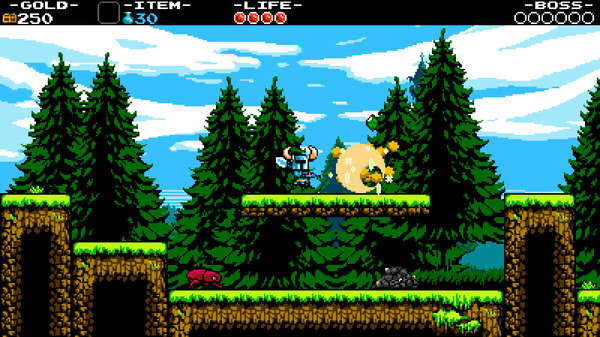
For instance, let us take “Shovel Knight, a popular pixel art game for example.

A screenshot of the game, Shovel Knight.

Despite the seemingly aged graphics, this is a game that was developed in 2014 but reported sales upwards to two million copies sold across all platforms in just over five years.

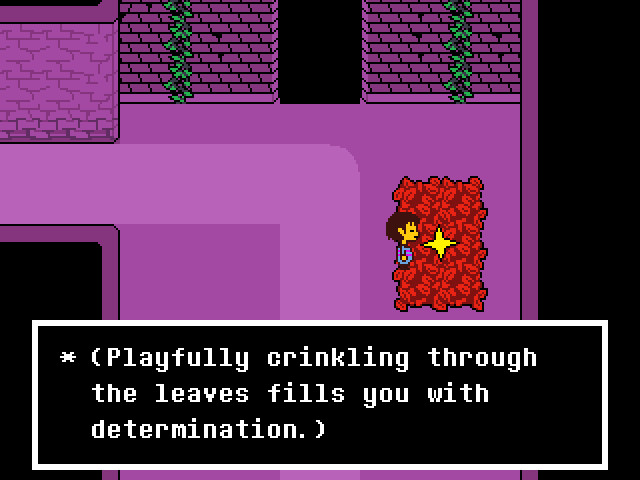
Of course, only one example would not be convincing enough for a proper research. Introducing “Undertale“, a 2D roleplaying game developed in 2015, that is also entirely designed with pixel art graphics. It’s a game that shook the Internet by storm, and though the total sales are not officially disclosed, there is an estimate of over 3.5 million players from data dated at 2018.(Orland, 2021)

A screenshot of the game, Undertale

These are all evident that pixel artists are indeed a welcome resource in the gaming industry, as even simple graphics can still top the sales charts when it fulfills the criteria of being able to connect visually with the players.

Challenges with my niche

To be frank, though I have been doing pixel art for a long time as a casual hobbyist, I have little experience in doing actual traditional art. Thus, it is not a field that I am confident in. I fear that since this is an art-focused niche, I would have to market myself against the millions of other artists on the Internet. And it is very difficult to stand out, when it is an oversaturated market with incredible talents across the globe that can constantly make you reconsider your personal qualities when looking at the art of others.

That is why, despite pixel art being my chosen style of art, I would have to discover my own style within this style – for the lack of a better word. It is easy to make pixel art, but true mastery would definitely take many years especially to the average man.

Thus, I must make an attractive portfolio and build an online presence for success in this field. Many pixel artists are also expected to know how to animate, and thus it is also an aspect of the field that I am learning in my spare time.

References:

Web.archive.org. 2021. Two Million Copies of Shovel Knight Sold!! | Yacht Club Games. [online] Available at: <https://web.archive.org/web/20200215033824/https://www.yachtclubgames.com/2018/04/two-million-copies-of-shovel-knight-sold/&gt; [Accessed 12 September 2021].

Orland, K., 2021. Valve leaks Steam game player counts; we have the numbers. [online] Ars Technica. Available at: <https://arstechnica.com/gaming/2018/07/steam-data-leak-reveals-precise-player-count-for-thousands-of-games/&gt; [Accessed 12 September 2021].

What is my media niche?

A brief introduction

Let’s take a look back about two to three decades back, where gaming had found its place in the global market. The first handheld console of the Gameboy franchise was just released in Japan, 1989.(Game Boy – Wikipedia, 2021) Though there were several generational competitors, the name ‘Gameboy’ is the most commonly recognized. It was one of the few revolutionary technologies for the many consoles that were to follow.

Tetris User Screenshot #7 for Game Boy - GameFAQs
Screenshot of Tetris, on the Nintendo Gameboy

However, there was only a limited amount of palettes that could be displayed on the screen. It was not capable of simulating photorealism like that of the modern AAA+ games we see nowadays. The common factor we see in all of the Gameboy’s games were that it was all in 8-bit pixels, as shown below.

original game boy mario - Online Discount Shop for Electronics, Apparel,  Toys, Books, Games, Computers, Shoes, Jewelry, Watches, Baby Products,  Sports & Outdoors, Office Products, Bed & Bath, Furniture, Tools, Hardware,  Automotive
How games used to look like, within the Nintendo GameBoy

My niche is in producing pixel art. It’s often associated with gaming due to its background, but it is most definitely a style of art. As an avid video gamer, pixel art also serves as a passion that links my love for gaming. It’s also interesting that you could literally work on art with the resolution sizes of 32×32, 16×16 or even 8×8 – all depending on what you want to make. Arranging pixels at an analogically microscopic level to make the big picture pop is what I feel this whole style is about.

A little pixel art portrait I did, in a slightly stylized Gameboy style.

Does this style of art have any media presence? What kind of people are the target audience?

There is a growing trend where indie game developers endorse the pixel art style, mainly due to it’s simplicity and its minimalistic nature. (Kordic, 2021)

The graphics of the most popular games requires a lot of personnel especially in the 3D modelling department, where mesh and texture creation could be handled by separate personnel and thus requiring more upkeep cost. 3D modelers also tend to be more expensive to hire, and producing a 3D game also requires powerful computer rigs.

All of these can be circumvented through the adoption of pixel art, and there are real-world examples of low-budget pixel art games producing massive public attention. Other popular 2D pixel game titles include Terraria and Stardew Valley.

7 Tips for High Scores on Flappy Bird | PCMag
An example of a very simple game in pixel art graphics, yet achieving incredible online popularity. Flappy Bird belongs to developer Dong Nguyen.

During my time as a pixel art freelancer, there were several small indie game developers that had contacted me to work with them. Given my first-hand experience, I am of the belief that this style of art has a strong popularity aimed towards game developers. It can be nostalgic too, for the older generations who have used to play retro games several years ago.

The Ethnographics

For every journey there is a beginning. Through I had started as a hobbyist, my horizons had further broadened when coming across certain blogs and YouTube channels related to the subject.

MortMort has a YouTube tutorial series and guides on how to produce certain pixel arts, like that of doing an animated game character or creating tilesets for environmental graphics in retro.

Studio Miniboss is a blog that creates tutorials on how to make and animate pixel art. It helps me a lot when being commissioned for producing certain 2D game assets.

References

En.wikipedia.org. 2021. Game Boy – Wikipedia. [online] Available at: <https://en.wikipedia.org/wiki/Game_Boy&gt; [Accessed 4 September 2021].

Kordic, A., 2021. What Exactly is Pixel Art and How Did It Come Back to Life ? | Widewalls. [online] Widewalls. Available at: <https://www.widewalls.ch/magazine/pixel-art&gt; [Accessed 4 September 2021].

Miniboss. 2021. Pixel art tutorials. [online] Available at: <https://blog.studiominiboss.com/pixelart&gt; [Accessed 4 September 2021].

Youtube.com. 2021. MortMort. [online] Available at: <https://www.youtube.com/channel/UCsn9MzwyPKeCE6MEGtMU4gg&gt; [Accessed 4 September 2021].