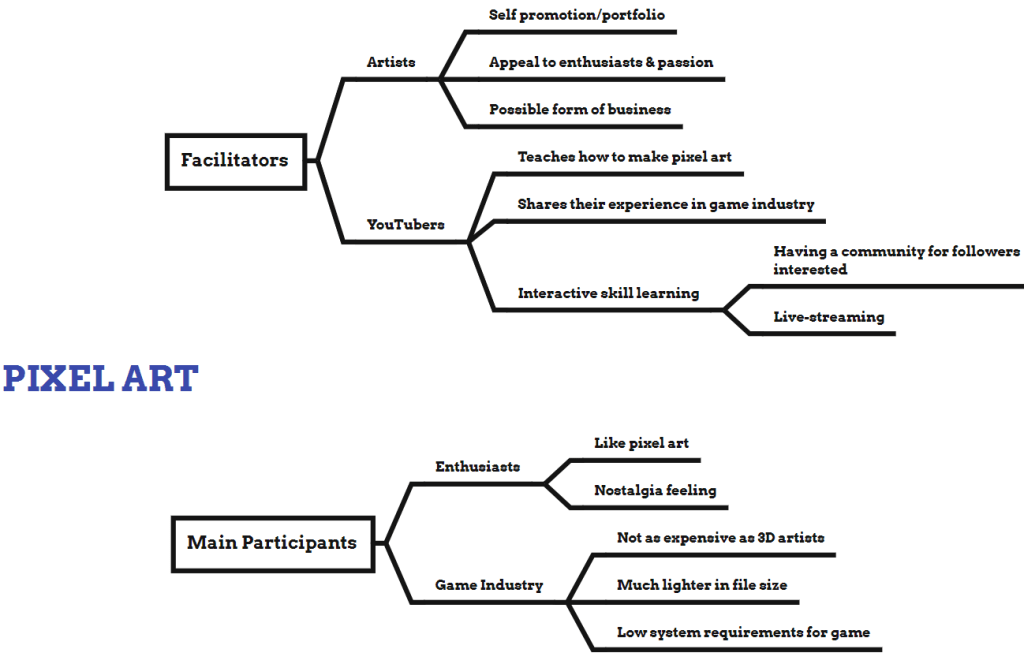
As shown in my previous blog post, my niche is pixel art, which is a style of art. It’s distinguishable, and not something seen very common which holds true to the characteristics that I would consider ‘niche’. That is why it is especially important to fully delve into this topic and investigate if it is fitting to be a valid digital artefact, under the lens of ethnographic study.
How relevant is my niche to future careers in the creative industries?
Pixel art is often associated with video games for most people. Not only is it a matter of nostalgia for the old-school games with limited graphics, it is also an art style that is closest to symbolizing gaming.
Nowadays, there are many aspiring game developers across the globe and a number of them have made their own indie game development teams. A popular trend seems to be pixel art due to its cost-efficiency in its compact size, allowing most systems (even low-end PCs) to run their games as well as pixel artists generally being a more affordable alternative to 3D graphic artists. However, this is not to say these games do not end up being just as popular as mainstream games.
For instance, let us take “Shovel Knight“, a popular pixel art game for example.
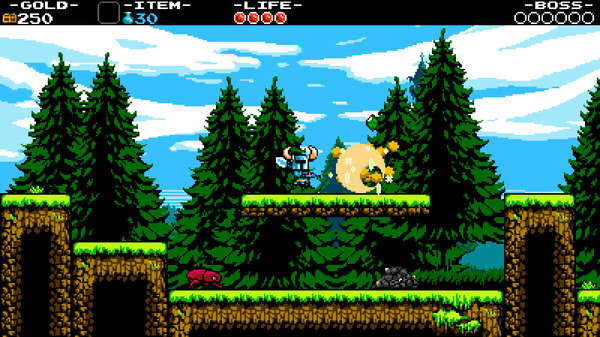
Despite the seemingly aged graphics, this is a game that was developed in 2014 but reported sales upwards to two million copies sold across all platforms in just over five years.
Of course, only one example would not be convincing enough for a proper research. Introducing “Undertale“, a 2D roleplaying game developed in 2015, that is also entirely designed with pixel art graphics. It’s a game that shook the Internet by storm, and though the total sales are not officially disclosed, there is an estimate of over 3.5 million players from data dated at 2018.(Orland, 2021)
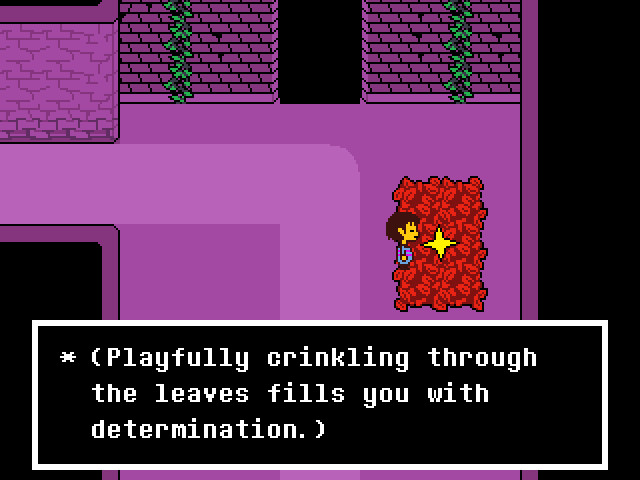
These are all evident that pixel artists are indeed a welcome resource in the gaming industry, as even simple graphics can still top the sales charts when it fulfills the criteria of being able to connect visually with the players.
Challenges with my niche
To be frank, though I have been doing pixel art for a long time as a casual hobbyist, I have little experience in doing actual traditional art. Thus, it is not a field that I am confident in. I fear that since this is an art-focused niche, I would have to market myself against the millions of other artists on the Internet. And it is very difficult to stand out, when it is an oversaturated market with incredible talents across the globe that can constantly make you reconsider your personal qualities when looking at the art of others.
That is why, despite pixel art being my chosen style of art, I would have to discover my own style within this style – for the lack of a better word. It is easy to make pixel art, but true mastery would definitely take many years especially to the average man.
Thus, I must make an attractive portfolio and build an online presence for success in this field. Many pixel artists are also expected to know how to animate, and thus it is also an aspect of the field that I am learning in my spare time.
References:
Web.archive.org. 2021. Two Million Copies of Shovel Knight Sold!! | Yacht Club Games. [online] Available at: <https://web.archive.org/web/20200215033824/https://www.yachtclubgames.com/2018/04/two-million-copies-of-shovel-knight-sold/> [Accessed 12 September 2021].
Orland, K., 2021. Valve leaks Steam game player counts; we have the numbers. [online] Ars Technica. Available at: <https://arstechnica.com/gaming/2018/07/steam-data-leak-reveals-precise-player-count-for-thousands-of-games/> [Accessed 12 September 2021].

