My digital artefact is a trilogy of blog posts which looks far into the future on how cryptocurrency and CBDCs would impact the world and its future economy systems. As a crypto investor, I believe that the blockchain is the revolutionary technology that could drastically change the world in the coming future, hence I felt it was an appropriate topic to present in my digital artefact. We can already notice present trends with mobile payments and credit cards becoming popular forms of payment alongside physical money, and that physical money is sharply declining in popularity among countries like Sweden. Blockchain technology can become the necessary push to drive societies to a cashless future, where the people rely on electronic money rather than physical currency.
Methodology
I decided to produce my digital artefact to consist of three blog posts. The reason behind this is because I wanted to include a wealth of information, made evident with statistics and cultural references to help provide similar connections or analogies for the reader. Videos relay interesting visual information, but they would require viewers to commit to watching the content, which could be lengthy with lots of information. In blog post format, I believe more people can read through the ideas of my digital artefact faster.
The first blog post gives a brief history lesson on how cryptocurrency began, which alludes to the making of CBDCs in the present day. The second blog post connects present day trends which show great statistical increase in electronic payment systems around the world. These trends helped me forecast and envision a future which my related topic would considerably influence, and discuss the foundations on how such a future would look like. My third and final post is built in compliment to my second post, with a greater focus on the social impacts and outlining the differences between the future and the now.
Background Research
As stated in my pitch, I derived much of my research from second-hand sources such as academic sources and news articles. As a crypto investor, I also personally do my own research in looking into the potential of different cryptocurrencies as well. Furthermore, there are also a lot of YouTube videos which introduced me to many new concepts and ideas about the Blockchain which I could incorporate into my digital artefact. These all contributed into building a cohesive mind map of ideas which makes up my vision of the future.
Utility
My digital artefact remains true to my intended target audience as stated in the pitch. Investors, interested students or businesses are the main focus that this digital artefact is aimed towards. The most important thing for any investor is to know the future of their investments, and that necessitates intensive research. This digital artefact may not be immediately helpful for the short-term investor, but I believe it has value in the long term.
“An investment in knowledge pays the best interest.” — Benjamin Franklin
Success & Challenges
Personally, I found the greatest struggle in limiting my ideas of the future to specific applications of the Blockchain. There is an incredible amount of applications that Blockchain technology can offer beyond what my digital artefact discusses, which makes me need to organize my ideas thoroughly to produce an article that isn’t too lengthy for the reader.
There were also a few comments which validates my digital artefact in being helpful, when they noted that they had learned something about cryptocurrency and CBDCs.
Such as:
That’s it for my contextual essay. Thank you for your time.
In this final episode of my digital artefact, I will discuss further on the differences between the future and the now with the mass adoption of Blockchain technology in our theorized future parallel currency system. This post could even hopefully serve as a guideline on what to expect from then and now, should this future come to be. However, please be aware that this is just conjecture based on a future possible outcome. There is no one who knows what the future may hold, after all.
To follow upon my reasoning in Post 2 where I mentioned that the COVID-19 pandemic is placing many countries in tremendous national debt, we discussed the government’s interest in adopting Central Bank Digital Currency (CBDC) as a means of collecting taxation as appropriate and hence being additional costs to the products we buy using CBDCs. We also discussed on how cryptocurrency would become mass-adopted by the people as a means of circumventing these extra tax costs, and this ultimately results in a society which utilizes a parallel currency system. This is not to be expected as true for all countries, given the difference in various political systems and the possibility of cryptocurrency being banned altogether; such as China’s ban on cryptocurrency in late September 2021.
The Differences
Through the use of CBDCs, governments are able to monitor and track the shopping habits of their citizens. This enables them to tax and charge interests as accordingly to cater with each citizen, and eliminate several problems of physical cash such as counterfeit money. However, likewise with the nowadays trend, our personal data is valuable for private companies to direct their advertisements to their target audiences. We can assume that our CBDC shopping habits could potentially become data that can be sold by our governments in the future as a source of revenue. CBDCs also can allow surveillance states to further control their citizens, and their information can be a factor in adjusting each individual’s credit scores.
However, there will likely be a sharp decline in physical robberies issues under this system. Neither banks nor shops would keep large amount of physical money in storage, and wallets would carry nothing but cards that can be locked at anytime. The unpermitted usage of another person’s CBDCs makes the thief liable to being tracked down even more easily by the police. Similar to cryptocurrency, each CBDC has a digital signature under the blockchain database which also makes it almost impossible to reproduce counterfeit.
In envisioning a future with a parallel currency system, we may see shops and merchants providing two different prices where one is the pricier CBDC (due to taxes), or cryptocurrency with the more humble costs. This can make cryptocurrency a more popular form of payment, but it would not contribute to your credit score as it was not issued by the government. There would be means that necessitate the usage of CBDCs, such as the payment of bills for providing proof of address in official proceedings. Cryptocurrency on the other hand, could be used as the anonymous means of payment while also remaining popular among private sectors. Cryptocurrencies such as Bitcoin will likely serve as the new global currency in the future and will be the main way of handling transactions in businesses around the world, similar to how powerful the US dollar is nowadays.
Many of the various cryptocurrency nowadays are valued based on how they can affect the real world through their blockchain application, which attracts investors that bolster their value. Blockchain is not only a revolutionary technology in evolving money transfers, but can be applied to various means such as tracking supply chains or e-commerce and smart contracts.
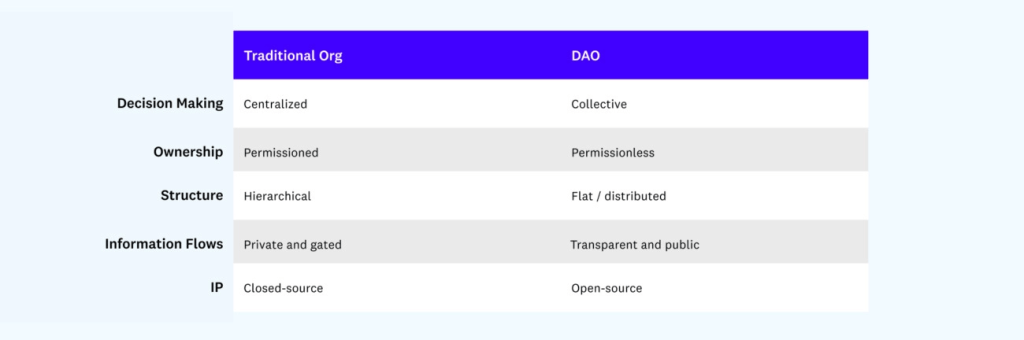
In this futuristic scenario, we can assume that Blockchain technology’s smart contracts would be applied by private businesses which become Decentralized Autonomous Organizations (DAO) and become widespread. Automation would likely replace many jobs, and cause mass unemployment when blockchain alone can become the singular driving force for a company with zero human employees. To illustrate the key differences between DAOs and traditional companies, please refer to the image below.
Since COVID-19 spurred on the paradigm shift of the gig economy in present day trends, we can expect more freelancers in the future aswell with how DAOs would become prevalent. Many people would likely not work for a company in the future as we still do today, and not everyone is suited for a fully digital knowledge-based society. To combat the future social issue of mass unemployment, this is where we can expect Universal Basic Income(UBI) to be commonly adopted by the governments as a means of distributing CBDCs. One of the biggest difficulties in applying the UBI financial policy is due to the additional costs that come with distributing money to each eligible citizen when it came to physical cash. With CBDCs, these transfers can be done immediately to all whitelisted citizens of the nation.
For many people that want to earn more than their UBI, popular means of earning would likely be through content generation with human creativity, and future digital services which may earn them cryptocurrencies. Just like in the Ready Player One(2018) movie where we assume the VR worlds such as the Metaverse is fully actualized in the future, we can earn cryptocurrencies through gameplay and they would have the value of real money.
We can also look to new media that are starting to be developed which touch upon this topic, such as the film “Crypto” (2019) which serves as a nice cautionary tale on what to expect from the world of cryptocurrency. Money laundering is still presently exploitable when it comes to cryptocurrency, and in the movie, we are introduced to a character who regularly does so with the deadly Russian mafia.
However, cryptocurrency also have the capability of changing their properties overtime. For example, one of the biggest cryptocurrency Ethereum has plans to shift from Proof-of-Work to Proof-of-Stake in its upgrade. This proves it is possible that future cryptocurrencies could be upgraded to tackle such issues. What do you think will happen in the future? Time can only tell with how fast technology is evolving each day. Sooner or later, we’ll find it change the world perhaps even far more than what I’ve just described.
Peer engagement is valuable in having one assume the role of both investor and advisor, providing both encouragement, advice and constructive criticism throughout the development of your projects. These types of people also will exist in the workplace and in future projects that one ventures.
In this task, I am to provide reviews on my three assigned students: Kwan Yuk Lun, Tasawar Arij and Cheng Win Yin (Gio).
Kwan Yuk Lun’s Beta on Androids
The first beta I’ve reviewed was Kwan Yuk Lun’s well-structured beta presentation. Though it is a theme almost omnipresent in science fiction, it is always a solid choice for in-depth research especially when we consider that researchers are constantly evolving robotics in real life. As humanity gradually advances technology, the spectrum of what becomes possible broadens and new ideas spring out. These new ideas could even potentially become unique to sci-fi culture, or become a paradigm shift in how we view robots as their possibilities or limitations become evident in real life.
I’ve provided suggestions and pointers to how Kwan Yuk Lun could produce his digital artefact, namely on how Lecture 8 thoroughly explores the various characteristics and bountiful information on robots. Furthermore, I also felt that Elon Musk was a very appropriate futurist to recommend in Kwan Yuk Lun’s research. I used to watch a few videos on his thoughts on AI and robots. Elon Musk even made a pitch presentation to his investors on his Tesla Bot. Knowing how incredibly wealthy the company is in both riches and scientific achievements, I feel that Elon Musk may be pioneering one of the first robots. Therefore in my opinion, Musk is an excellent futurist to refer to in Kwan Yuk Lun’s digital artefact.
Arij Tasawar’s Beta on Fashion & Technology
The beta was exceptionally brief compared to the others, so I had a little trouble in providing a good review. I did not have much knowledge either in the topic, since there wasn’t really any brief examples of what was being presented with her digital artefact. It seems to be in line with most of the assignment’s criteria though, and there was a good focus on how she utilized a feedback loop to improve her digital artefact. However, I do look forward to what she could provide with the finalization of the project.
Personally, I do not have a good grasp on the concept of fashion so there was not too much I could say. I provided a lengthy documentary for her to look through as a reference material though since it explores quite deeply on the topic that Arij is interested in.
Giovanni Cheng’s Beta on Holodeck Technology
Finally, I was quite impressed by Gio’s beta presentation. It was a full package of entertaining visuals, proper flow & structure, and information. Many people would likely not know what a ‘Holodeck’ is supposed to be, but many relevant images and video clips (from Star Trek) was provided. These fitting media presentations all coherently built a general idea and concept throughout the video to be understandable, and I felt there was talent at play when it came to garnering the viewer’s interest in the topic. Should you look at it in a business perspective, it is an appealing beta when seen by investors.
First impressions aside, I was able to connect the concept of the Holodeck being similar to one of the VR projects I am interested in. As an avid fan of virtual reality technology, I follow a number of VR projects. Varjo’s Reality Cloud is one of them, and it is quite similar to the Holodeck. Since it is an ongoing project in real life, I believed that intensive research into them could be great for reference in Gio’s Holodeck digital artefact. Finally, I also pointed him to Lecture 10 which could reinforce his digital artefact’s discussion on ethical issues on the technology as it discusses technological determinism and social constructivism. For instance, with how some blame video game violence for influencing people in reality, it is also a concern if you could use the Holodeck to reproduce similar psychological issues that may make it a cause for blame.
The classes have been an odyssey throughout the gradual development of the science fiction genre we know today. The movie screening sessions have not only been fun, but proven very valuable in showing how the cultural media influences our perception of the future. We are seeing through the lens of visionaries build upon the ideas of one another as they inspire each other through film, ultimately crafting a beautiful network that connects all its elements to one genre: science fiction.
For the several movies screened in Weeks 7 to 12, I have actively expressed not only my fascination with the evolution of technology, but also actively discussed points of interest in my observation of the movies. For this blog, I will be posting tweets that either achieved a highly liked feedback or tweets that have initiated a successful discussion with my class.
In the span of 28 days, I’ve managed to produce a sizeable bump in my twitter analytics which is an encouraging statistic. From the analytics page, we can observe further trends such as what my most liked tweet is within the Week 7 to 12 timeframe.
#bcm325 The movie feels closest to pessimistic prediction scenario, perhaps because it showcases the dystopia.
Not only is there a class system division in the floating utopia Zalem & dystopian Iron City, there were wars and societal problems arise like jacking cyborg parts.
With 10 likes, 161 impressions, 4 retweets and three replies, this is my most successful tweet as it shares my opinion of the movie Battle Angel Alita from my perspective. It encouraged three others to reply with their views on the future as depicted in the film, as shown in the below figures.
The responses of my top tweet
Furthermore, let us investigate another top tweet according to the twitter analytics.
In this tweet, I have connected a real local social issue as the movie was about an old man living alone. I noticed that there was a potential in garnering some class discussion with the use of such healthcare robots in the future in hopefully tackling the problem. Unfortunately, I was not really able to get any replies but many people seemed to have liked the tweet with a few retweeting it. Though I think it was the right approach to formulate a well-received tweet, it is in hindsight that I realize I should cut down the word count whenever I intend to ask a question.
Finally, dialing the clock a bit back towards February in the Robot & Frank (2012) screening, my top tweet of all time has achieved 420 impressions with a high number of engagements numbering 19.
Contrary to the previous tweet, this is a thought-provoking question which appeared effective in producing satisfactory engagement as there were interesting and speculative discussion among the class. Perhaps discussing the precautionary measures of dealing with highly intelligent AI in the future is a surprisingly good conversation starter?
One of the longest conversations that I have managed in Twitter has been a fairly fruitful one with sharing with my fellow peers on futuristic advancements. I’ve embedded the tweet in this post for a more convenient reading experience in scrolling through the replies. I think this is a valuable tweet in having produced a very engaging topic.
#bcm325 Right off the bat, we are presented with the concept of futuristic engineering achieving the possibility of flying cities. The architecture looks very alien and sci-fi.
Nowadays people do land reclamation from the sea, but do you think we'll eventually live in the skies? pic.twitter.com/1hAT0jvGjj
In conclusion, the live tweeting was a surprisingly very fruitful experience. As someone who tends to shy away from social media, this assignment has shown me the potential educative values of social media especially in an academic setting. Twitter served as a good platform for interaction with the class, and has pushed me to develop skills of live commentary. Not only that, I have even gained some likes or retweets from people outside of the class with my stating my observations of the sci-fi media.
In producing this 1 minute digital artefact, there was a time constraint of 1 minute according to the assignment, so I had to deliver as much vital information as possible. For the first introductory part of the video, I presented a few facts about loneliness in order to emphasize the problem to the viewers and to let them know the severity of the social issue nowadays.
This allowed me to build a logical connection towards the main product I would be selling as a solution to investors in considering this product against social issues. I had intended to include more data more about the auxiliary benefits, but within the time limit of 1 minute, I had to only include the essential information while also maintaining a clear readability to the audience.
A few scenes present in my video come from real world examples, mixed with media such as Detroit: Become Human(2018) and Robot & Frank(2012). The purpose of these are to showcase what the design or functions of the product would look like. It was necessary to present multiple cultural media material from video games in order to give the most accurate portrayal of our product, so that our claims can be backed up with some visual ideas. Notice that the above figure of our product design has a humanoid structure, which led me to believe that using humanoid robots as models for our work is the best way to show our product.
Our design of Companion Robot, courtesy of Liann
As many advertisements nowadays are about 15 or 30 seconds long, with short promotional videos lasting up to 1 minute usually. This advertisement trend makes me feel that my 1 minute digital artefact is similar to that of a promotional video, and so I wanted it to encompass an impactful feeling as I edited the video transitions to be consistent with the melody of the background music. Let’s take this promotional video by Adidas as an example, which lasts about 1 minute.
Let us take this video as a brief reference to the structuring of my video. Consider how this promotional video has a slow build-up from the first 20-30 seconds, but changes to an exciting music afterwards. This video is a role model for me with its staggering 44 million views. My promotional video is also designed similar, and I believed following the example of successful marketing structures like this would be the most effective way to do the 1 minute video. There is not an information overload in my video, but timed enough for a general audience to follow with a clear and consistent message throughout a video. I also made most messages have a black or white background to follow, in order to contrast the text with the background and clearly present it.
Clarity of message and an impactful way of delivery has been my main focus in producing the digital artefact. Though it cannot fit much information, the purpose of a promotional video is to make the viewer interested enough to search more on the product or is redirected towards the product’s website. In that respect, I believe my digital artefact has been effective in delivering its intent.
Can you imagine a future where physical money, like coin and notes, could eventually become relics of the past? Society may be becoming a lot closer to the actualization of such a future than you might think. Over the past years, many developed countries are progressing towards a cashless society as the convenience of swiping a card or payment by app is becoming more the norm for regular consumers. These are telling signs that we are headed to the era where money is now electronic and digitalized. With the adoption of Blockchain technology, the cashless future has just become all the more likely.
Evident trends supporting this vision
Let’s bring up a few examples. In 2012, China’s digital payments used to be 4% of all transactions. However, this statistic jumped from 4% to 34% in 2017. According to a 2018 survey in China, 92% of urban citizens in the cities used mobile payments as the main means of payment with the rural population making up for 47%. This indicates an incredible penetration rate with mobile payments, and that it is a way of life for many people.
Sweden is another country at the forefront of the cashless transformation. According to Sweden’s central bank, the number of Swedes that used cash had fallen from 39% to 9% respectively from 2010 to 2020. It is usually the elderly or tourists that can be often seen still using cash. There are many shops in Sweden that do not even have a cash register, and only accept electronic payment. Furthermore, the Central Bank of Sweden is also planning to make their own Central Bank Digital Currency (CBDC), the e-krona. In the near future, I believe Sweden is likely the closest to becoming a truly cashless society.
The OASIS coin from Ready Player One
If we are to refer to cultural representations, we can look towards how the OASIS coins worked in the VR sci-fi film Ready Player One (2018). These electronic coins existed only within the digital world of OASIS which is accessible through Virtual Reality technology, and did not exist in reality. However, they have value which can translate to real money and have purchasing power just as physical money does.
Many of their characteristics are shared with the cryptocurrency and CBDCs in reality, and they would likely become the currency that would power the virtual worlds of the future. The Metaverse is an excellent example of an real life project to develop a similar virtual world, and it has been no secret that Meta’s CEO Mark Zuckerberg is interested in applying Blockchain technologies to the economy of user-owned crypto assets and data.
When we apply the concept of Technological Determinism with Blockchain technology, we can infer that this technological advancement implies being part of the digital-based currency system in bolstering the security of such money in the future.
There are a number of factors that support my thoughts in how we would no longer use physical cash in the future, besides these trends. Fears of the COVID-19 pandemic spreading through physical cash exchanges has pushed many people around the world to switch to electronic payment, and the global attention surrounding cryptocurrency & blockchain technology would further expand the versatility of electronic pay.
The issues of physical money
Let’s check out a few obvious problems first. Hard cash needs to be carried around, and you can’t easily bring huge amounts of money without keeping them in containers like suitcases. They need to be properly sorted with calculating appropriate change whenever using cash to buy things physically.
Money can also be stolen, and there are frequent robberies that are often on the news in countries like the US. Money laundering, counterfeit and tax evasion are also issues that physical cash has. Did I mention that physical money are made of either metal or plastic/paper, and the mass printing of money has an adverse effect on the environment? Large reserves of money also need to be protected in vaults, and transported in armored trucks with appropriate security measures. Some studies have shown that countries can save up to 0.5% to 1% of their GDP by transitioning into a cashless society, which means roughly $150 billion for the US a year.
One of the biggest hurdles for nations in becoming a cashless society was the possibility of hackers being capable of hacking banks and electronic money, but with the new Blockchain technology present and thoroughly researched by governments all around the world nowadays for absolute security nowadays, it would make such a feat almost impossible.
Image source: Shutterstock
The future’s digital, parallel currency system
I envision a future, perhaps in 25 years or later, where cryptocurrency and CBDCs coexist with one another as dual currencies in the future’s economy for many countries, particularly the developed. These two currencies would both be standard use in the market, and they may even have differing prices. I believe that cryptocurrency would be the cheaper alternative to CBDCs in paying for products in this future, especially when we consider a few important points about CBDCs. Firstly, it is a digital currency that is issued and regulated by the government or the central bank.
In the present day, many countries around the world have tremendous national debt piled up due to the COVID-19 pandemic. To back up this claim, I will present related news articles referring to the debt of various countries. According to a news article on The Guardian, the public debt of Britain is greater than the country’s own economy due to having borrowed roughly £55billion due to the coronavirus pandemic. Developed countries such as Germany, Japan, Canada, China and the US have all suffered a similar debt spike due to the COVID-19 crisis. According to Bloomberg’s 2021 article on the matter, global debt has risen by $19.5 trillion during the pandemic and it has likely risen even further since then. With how the COVID-19 pandemic is still showing no signs of stopping in the time of writing this in 2022, the debt only grows worse for our global leaders.
How could cryptocurrency and CBDC possibly become mass adopted in the future?
Taxation is one of the income streams for our governments, and it is how the crippling national debt could be resolved overtime. Depending on how our national leaders handle it, there may be spikes in tax prices for the sake of public finances in relieving the tax burden. If so, it would be an incentive for more people to look towards trading in cryptocurrency as a contingency against having to pay high tax prices. As a result, cryptocurrency becomes further popularized and mass adopted by societies around the world and this creates an environment where governments globally would use Blockchain into their currency.
In order to alleviate national debt, I believe CBDCs will likely charge extra tax and lead to higher prices, as it is essentially digital currency backed by the government. It is also important to remember that it is possible to perform tax evasion with physical cash. In tackling this issue and aiding the national debt, CBDCs would be introduced as the main form of payment by monetary authorities as it would allow the nation to keep track of the citizen’s money and to tax them accordingly.
In my next blog post, I will be sharing more on how this paradigm shift would shape the future economy of society compared to the present, and what such a future may mean for us.
Thank you very much for reading, and please stay tuned for my next post!
I realized that the most valuable lessons could be learned from how other people have lived their lives out in the workplace. From the lecturer herself inviting many types of guests, and allocating much of the lesson time for the class to act as an outsider witness. Though there are times where my attention span runs out from listening to a lecture too long, I felt that these sharing experiences from the guest speakers were too valuable and relevant for me to miss out on.
I’ve also learned a lot from the presentations that each individual student had to share with the class. They all varied from person to person, from different social classes, different beginnings and journeys. Some started off with a lot of capital, but some started from nothing but rose to success. A few even were the same ethnic minority students like me. Those stories in particular were captivating, and I wish I had known such hardworking and positive people in my club of life.
Inspiration, enlightenment and yet a bit of regret. Those were generally the feelings I’ve had when listening while applying White’s absent but implicit model with my own values. Many of these presenters are retelling an experience and story that is meant to resonate with others, and it is effective for the outside witness to also observe and reflect on the interviewee and their own values.
I felt that I had to go through a lot more hassle than most others in trying to find a person for an interview, as my social circle was meagerly small. I realized that I was not really close with any person out there in the world, besides my own family. No one besides me in my family works however, and my father has left the family in my care since last month so I’ve had to pay the bills.
I did not have any other close friends to ask in real life either, so I had to settle with a friendly client of mine online and present my part based on the information that they gave. Honestly, I did not know this person that well, and had to ask him stuff over text messaging alone. Fortunately, he had given some interesting content for my presentation and his profession seems like a future career path that my degree would qualify for.
Many of the questions I’ve directed to him were the relevant key questions as instructed in the guidelines for the assignment, though I did not go very deep into their personal life as I fear that we were not that close. His values resonated with mine when he speaks of the various elements that make up a good career, and he believes that a relaxing career can lead to a healthier wellbeing of yourself. I am aware of my weakness in handling social situations, so I heavily invest in finding work online as a freelancer. Making promotional videos & articles as my interviewee does is a relatable fit to what I want to do. One particular value that stuck with me is
I will admit that I am a negative person to a worrisome degree, and always had the looming dread that there was truly no future ahead for me. I had long determined myself as a person without worth in a society where I could not even speak nor read the local tongue despite being raised here. Yet from the many sharing sessions, I had discovered that even such people with similar circumstances can still succeed. Though I still barely have any connections, I’ve made my first Hong Konger friend after over 10 years and the teachers here like Ms. Eugenie also seem more than happy to provide me job opportunities.
The Future of Work has been a blessing in allowing me to reevaluate my life and values in retrospect, and think onwards to the future rather than my habit of dwelling on the past. With the paradigm shift to the gig economy nowadays, the course has shown me the light that I can achieve what I want to do in the future as an online freelancer.
Thank you very for teaching us, Ms. Maria Fung. I will always remember and treasure the patient kindness and wisdom you’ve shown me in the lessons spent together.
Ever since cryptocurrency has been popularized in the mainstream, you just hear about it all the time now. From conversations of your social circles, in your school books and now even in advertisements online! With its widespread talk spanning across all sorts of communities, it does make one wonder just what exactly is all the hype about.
Or perhaps you’re in the know about cryptocurrency by now, and it’s old news to you. But are you aware that the central banks are developing their own kind of cryptocurrency, known as Central Bank Digital Currency(CBDCs)?
In this blog, no matter how much or little you know, I’ll be briefly touching on what CBDCs and cryptocurrency are about – and why this matters to you!
What is cryptocurrency?
The story begins with Bitcoin as the first cryptocurrency. In 2008, An anonymous person known as “Satoshi Nakamoto” published whitepapers which acts as a blueprint to an “peer to peer electronic cash” system known as Bitcoin.
The purpose of this was primarily the decentralization of sending funds to one another, without needing to go through centralized financial institutions such as banks. This also means there would be no third-party middleman taking the cut from transactions made between two people. An good example of this is how a payment gateway like PayPal would take a service cut whenever I receive money from people overseas. Cryptocurrency would not have such a service cut, and it would not rely on the bank or the government on checking transactions which makes it anonymous. Furthermore, in the event where the central authority would shutdown, the money would lose its value. Decentralized currency are able to operate as long as the network exists.
Cryptocurrencies operate on the Blockchain, which is a system that acts as a digital ledger in keeping track of the transactions. This public blockchain is maintained by everyone in the network, and is constantly growing with more users. The Blockchain is also an extremely secure, which is why many companies are making projects of various ways to apply Blockchain technology.
Central Bank Digital Currencies (CBDC) are basically a centralized version of cryptocurrency that is issued by the central bank or the government. Their value is fixed to be the value of the country’s currency. CBDCs would work anywhere just like your physical cash, except through your phone or other electronic wallet devices like a smartwatch. Given the anonymous nature of cryptocurrency, it is understandable that there are many central bank and government authorities who dislike it, as it could encourage money laundering and tax evasion.
It is important to note that these aren’t just like the digital money from your credit card or your payment app. Though they are indeed digital, they are just credits and debits from between banks and payment providers like VISA & Mastercard. CBDC are directly from the central bank. Many countries nowadays are researching CBDCs as they are planning to transition to digital currencies. Much of these CBDCs would share the benefits of cryptocurrency, such as reducing cross-border transaction fees and also bolster financial security. It could also help governments send stimulus checks or COVID relief funds much easier if it was a society that has adopted CBDCs.
Photo: Kyodo
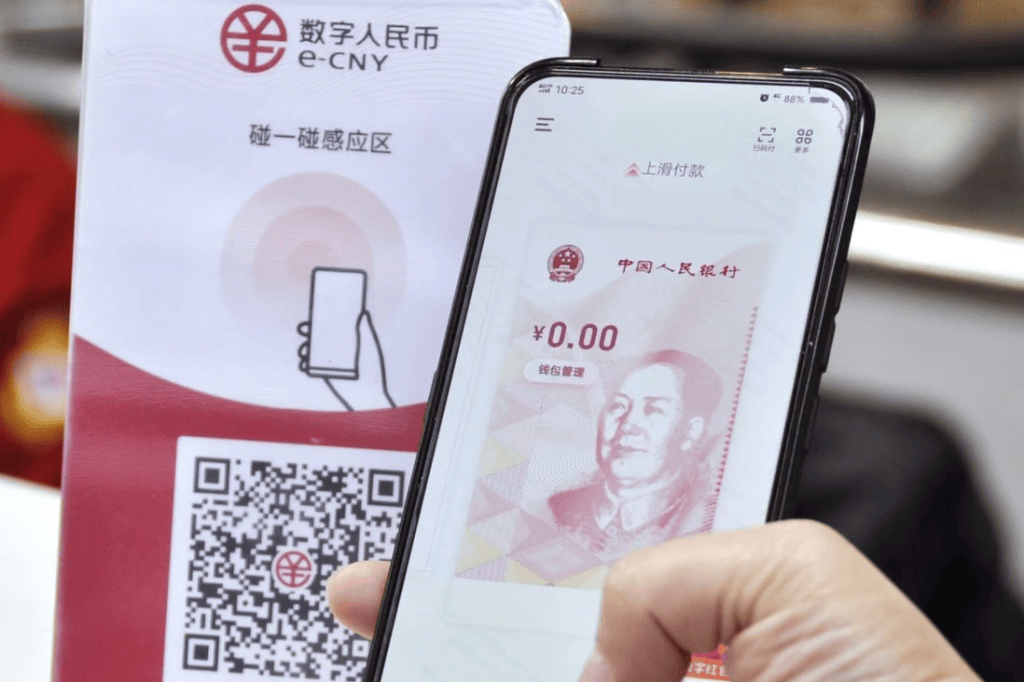
You may have heard of China’s revolutionary financial project in rolling out its digital yuan as part of its economy. It serves as an excellent example showcasing how CBDCs work. It requires only a simple download as an app, and would not require Internet as it uses NFC for offline payment. As your CBDC wallet is connected to the government, they are able to provide immediate financial assistance and provide appropriate tax and interest rates. It is also a countermeasure against counterfeit money and money laundering. However, it’s important to remember that depending on the country, the government may have the power to track your spending behaviors and adjust your credit score accordingly, or even freeze your wallet. Sounds like a scary technology under the hands of totalitarian regime, doesn’t it?
In my next blog, I’ll be sharing my visions on what the future has in store with these two types of currencies. You don’t want to miss it!
My digital artefact details roughly on the cultural influences and impacts regarding PlayerUnknown Battlegrounds. It is important to learn how video game incorporate inspirations from other existing media elements, and further produce communities and cultures to be built around its title.
Incorporating a certain constructive comment from my critical self-reflection, I made sure to begin the video with showing the origins to the Battle Royale genre first, which traces back to the 2000 Japanese movie of the same name. This influential cult classic further influences other media such as the Hunger Games, which carries relevant themes similar to current battle royale games. For example in the movie, ‘Sponsorship’ are airdrop supplies and are sent to the participants in the Hunger Games battle royale. In many battle royale games like PUBG, Fortnite and Apex Legends, they all have the similar characteristic of an airdrop supply crate which provides the player with more resources like gun and armors.
By having active community content generated by fans, it bolsters the popularity of a game and becomes valuable marketing that is cost-free for the developers. The purpose of the digital artefact is to provide an analysis of the game’s participatory media culture, and its constructions involve the user-generated highlight clips, artwork & memes that justify the research focus into those areas. These also tie into how the Reddit community of PlayerUnknown Battlegrounds has an astounding 1.9 million members.
As the subculture of Battle Royale has proven itself a market with popular demand, there have been also many other battle royale games being developed such as Fortnite and Apex Legends. It was said that Fortnite was meant to be a survival game fighting against zombies, before they shifted their model into the Battle Royale genre and exploded in popularity as a result.
Since the pitch video, I’ve managed to extend my imagination in regards to how the future world in roughly 25-50 years could change with the revolutionary technology of Blockchain.
My beta describes thoroughly my new plans after collecting feedback from various people about my pitch video. I envision that we may no longer rely on handheld cash in the future, and have a global connection where people have two main channels of payment between Central Bank Digital Currency(CBDCs) and cryptocurrencies such as Bitcoin and Ethereum.
Based on the current observable patterns of today, my Digital Artefact will focus on how the future smart cities throughout the world would adopt blockchain technology in the economy – and what social impacts may arise from all this.